SEO & AI Search
On-Page SEO Checklist: 19 Checks in Priority Order, With Results From 89 Real Articles
By Bibek Thapa · Updated · 14 min read
Quick Answer
An on-page SEO checklist covers what you control on a page: intent match, indexability, title, headings, depth, internal links, images, schema and speed. Work it in priority order. Intent and indexability decide if a page can compete, so they come before schema or image compression. Passing every check still does not promise a ranking.
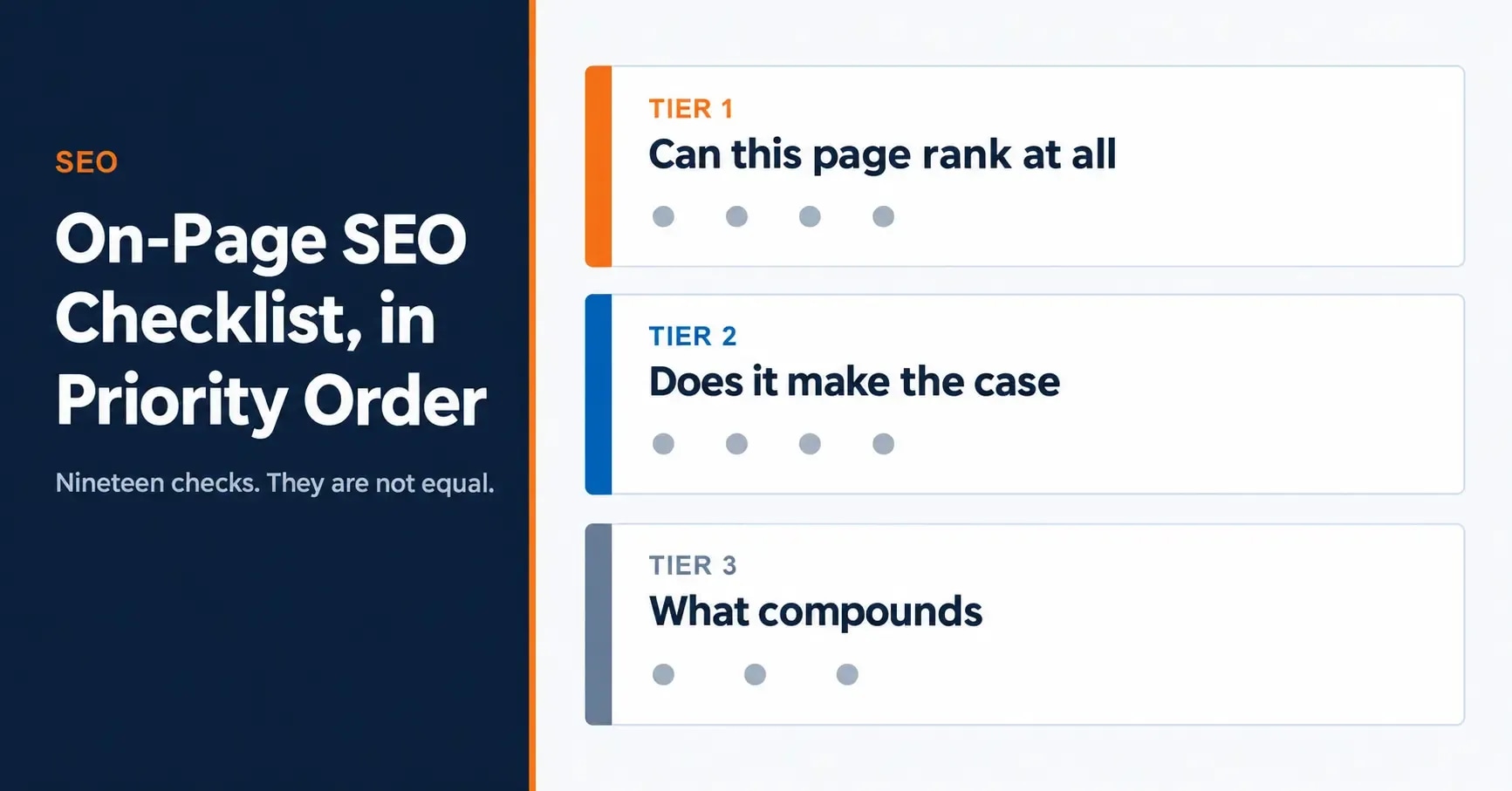
Table of ContentsOn this page
- What happened when we ran the on-page SEO checklist on 89 articles
- The on-page SEO checklist, in priority order
- Tier one: checks that decide eligibility
- Tier two: checks that build the case
- Tier three: checks that compound
- What to do when a page ranks but not well enough
- On-page SEO and AI features
- What E-E-A-T is, and what it is not
- Common mistakes
- Frequently Asked Questions
- Sources and References
Key Takeaways
- Work the checklist in priority order. Intent match and indexability decide whether anything else matters.
- Anobee's 89 articles all passed the title, meta, H1 and canonical checks, yet that alone did not make them rank.
- The real gap was links: 11 of 89 articles had no link from another article's body.
- Google says E-E-A-T is not a ranking factor, and that you can skip AI text files for Google Search.
- Google rewrote 61.6% of titles in one 2022 study, so make the title describe the page honestly.
An on-page SEO checklist covers what you control on the page itself: intent match, title, headings, content depth, internal links, images, schema and speed. Work it in priority order. Intent and indexability decide whether a page can compete at all, so they come before schema markup or image compression.
Most checklists treat a title fix and a schema update as equal work, and they do not show what happens when you pass. So on 6 November 2026 we ran the measurable checks on all 89 live Anobee articles. Nearly everything passed, one check did not, and this page shows the limit of a passing score.
What happened when we ran the on-page SEO checklist on 89 articles
We read the live HTML of every article in Anobee's sitemap. Eight checks can be measured that way.
| Check | Standard | Passed |
|---|---|---|
| Title length | 60 characters or fewer | 89 of 89 |
| Meta description | 120 to 160 characters | 89 of 89 |
| One H1 | Exactly one | 89 of 89 |
| Canonical | Points to itself | 89 of 89 |
| Robots | No noindex | 89 of 89 |
| Image alt text | Every body image has alt text | 89 of 89 |
| External sources | At least 2 outside links | 88 of 89 |
| Links from other articles | At least 3 | 54 of 89 |
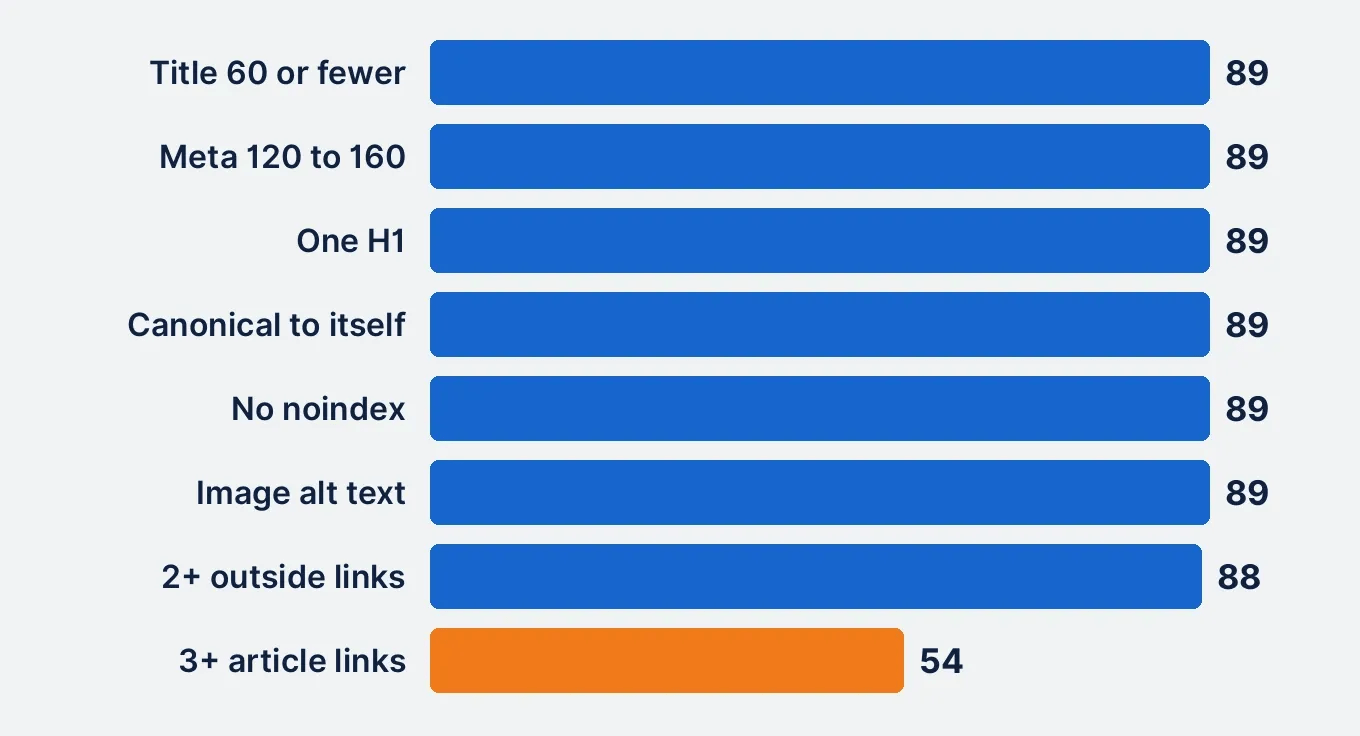
Internal links were the one real gap. Eleven articles had no link from another article's body, and 35 had two or fewer. Hub pages and navigation can still link to them, but those were not counted here.
This guide passes all eight rows, including 11 links from other articles, and it still averaged position 84.1 in Search Console from June to November 2026, for 857 impressions. For "on page seo checklist" it averaged position 88.6.
So an on-page SEO checklist is a floor, not a ranking plan. Passing removes obvious faults. Competition and links from other sites likely decide the rest. We have not measured those for this page, so treat that as our reading, not a finding.
The on-page SEO checklist, in priority order
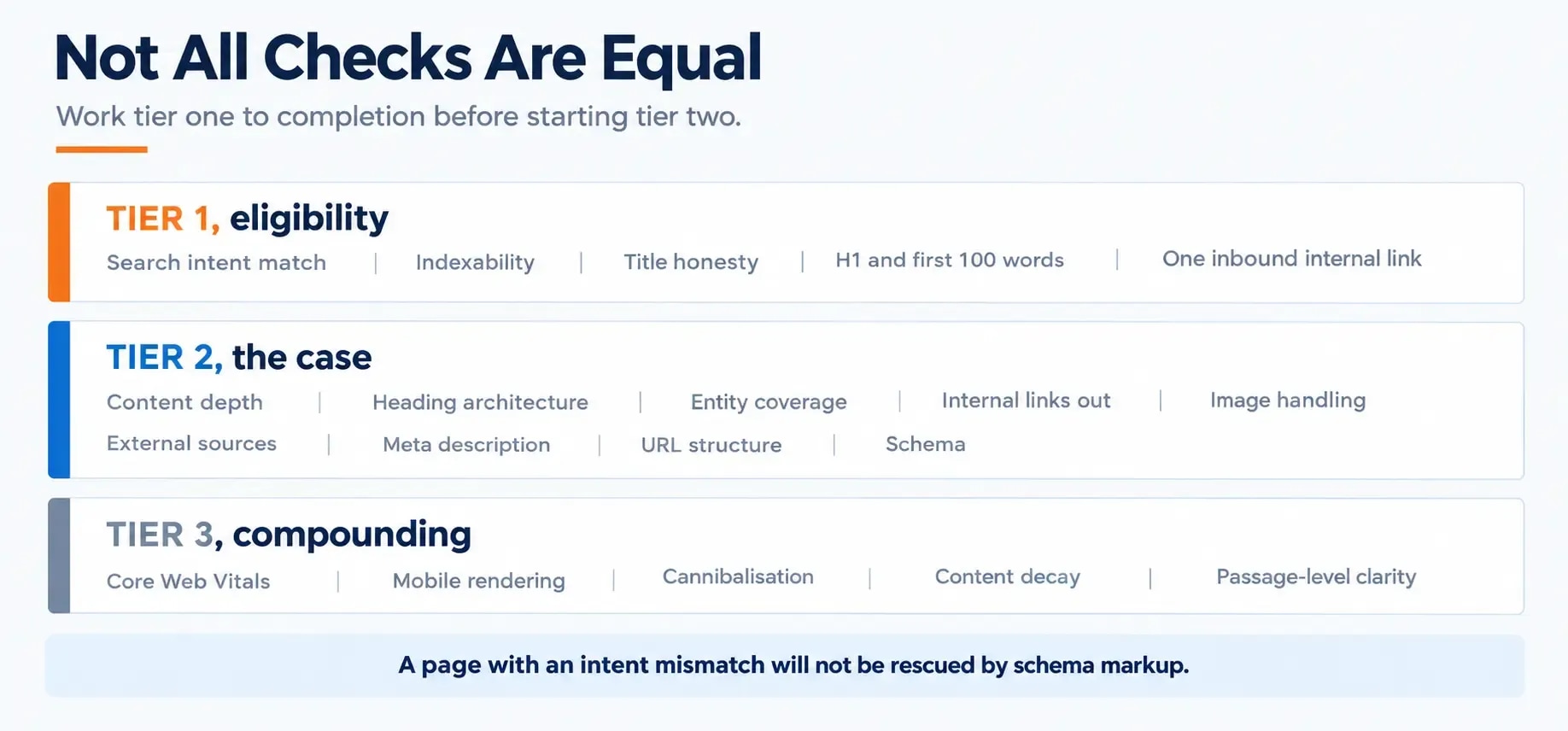
Work tier one to completion before you start tier two. The order is our judgement about leverage, not a Google hierarchy.
| Tier | Check | Why it sits here |
|---|---|---|
| 1 | Search intent match | Decides whether the page can compete |
| 1 | Indexability | A page Google cannot index cannot rank |
| 1 | Honest title tag | The title is the promise |
| 1 | H1 and first 100 words | Readers and crawlers decide here |
| 1 | One inbound internal link | An unlinked page may not be found |
| 2 | Content depth | Missing subtopics are a common gap |
| 2 | Heading structure | Makes the page easy to scan |
| 2 | Entity coverage | Shows the page covers the subject |
| 2 | Internal links out | Helps readers continue |
| 2 | Image handling | Alt text, size and dimensions |
| 2 | External sources | Makes claims traceable |
| 2 | Meta description | Earns the click, not the rank |
| 2 | URL structure | Costly to change later |
| 2 | Schema markup | Rich result eligibility |
| 3 | Core Web Vitals | Real, but secondary |
| 3 | Mobile rendering | Google indexes the mobile version |
| 3 | Cannibalization | Two pages competing for one query |
| 3 | Content decay | Pages slide quietly |
| 3 | Passage clarity | Sections that stand alone |
Tier one: checks that decide eligibility
1. Search intent match
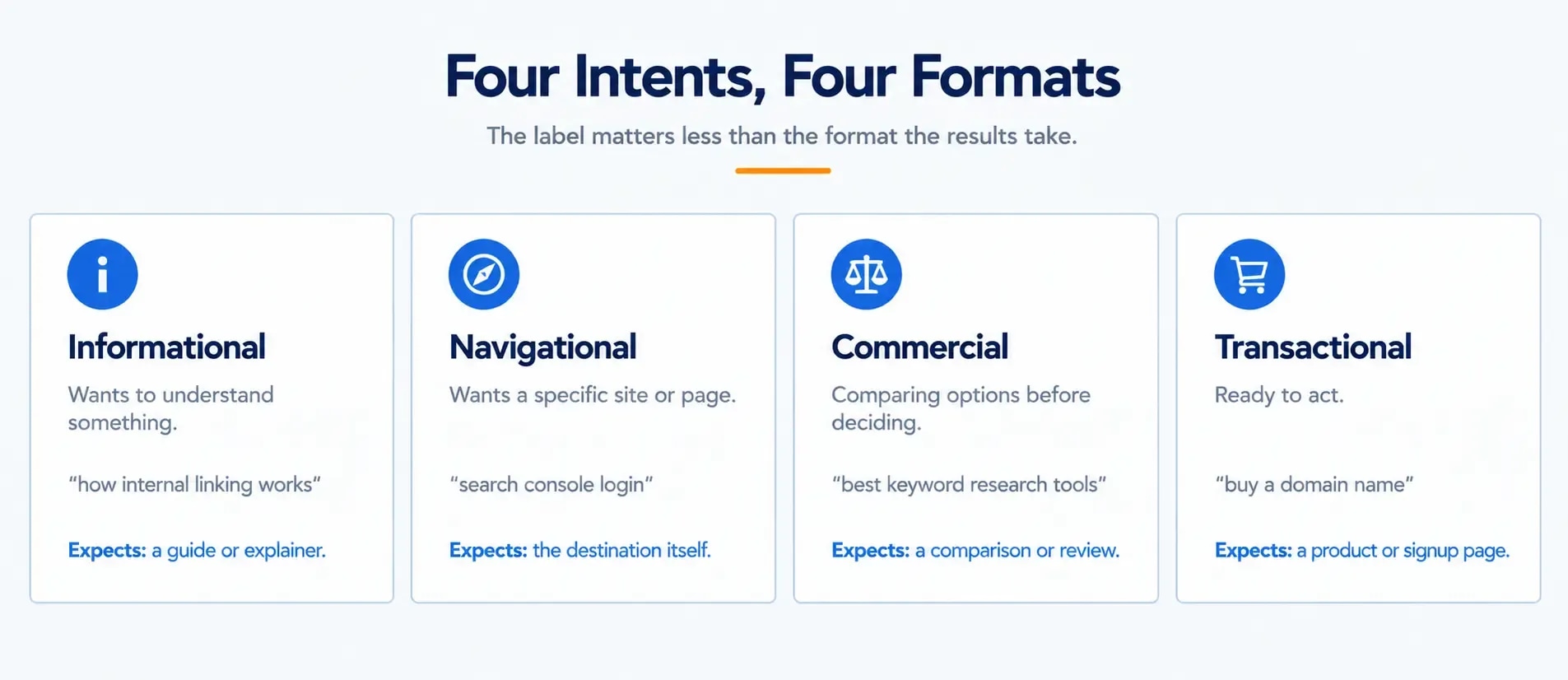
Search intent is the reason behind a query. Search your keyword and look at the top five results. If they are all comparison posts and your page is a product page, the format is wrong, and no title rewrite fixes that. Our search intent guide shows how to read a results page.
2. Indexability
Confirm the page returns 200, is not blocked in robots.txt, has no noindex, and has a canonical pointing to itself. An X-Robots-Tag header never appears in the HTML, so check the response headers too. URL Inspection in Search Console gives the authoritative answer.
3. Honest title tag
Keep the main phrase near the front, stay close to 60 characters, and describe what the page delivers. A 2022 Zyppy study of 80,959 titles across 2,370 sites found Google rewrote 61.6% of them [5]. A rewrite is not a penalty, but it does suggest that something else described the page better.
4. H1 and the first 100 words
Use one H1 that matches the title's meaning. Then answer the query in the opening paragraph, without warming up.
5. One inbound internal link
Google says it "primarily finds pages through links from other pages it already crawled" [1]. This is the check Anobee's audit flagged most. Our internal linking strategy covers how to audit a whole site.
Tier two: checks that build the case
6. Content depth
Depth is not word count. Open the top three pages, list every H2 they have that you do not, and add the gaps that genuinely belong. A page that nearly ranks is usually missing a few real subtopics, not thousands of words.
7. Heading structure
Do not skip levels or use headings for styling. Write them as descriptions: "How to find orphan pages" beats "Orphans".
8. Entity coverage
A topic has related concepts that belong together. Covering them matters more than repeating a phrase. Keyword density is a legacy metric, and "aim for 1 to 2%" has no basis in Google's guidance. Entity optimization goes further.
9. Internal links out
Link to pages that help readers continue. Google says good anchor text is "descriptive, reasonably concise, and relevant", and that there is no magical ideal number of links [4].
10. Image handling
Use descriptive file names, alt text that describes the image, modern formats and fixed dimensions. Lazy-load everything except the image likely to be the largest on first paint. The image optimization guide has real file size tests.
11. External sources
Link to the primary source for any claim a reader might doubt. This is a standard for honest writing more than a ranking lever, and it catches claims you cannot support.
12. Meta description
It does not rank the page. It influences the click. Answer "why this result?" in under about 160 characters.
13. URL structure
Keep URLs short, readable, lowercase and stable. Avoid dates and numbers you will want to change, because every later change means a redirect.
14. Schema markup
Schema makes a page eligible for rich results where it qualifies. It does not lift rankings directly. Use types Google supports, validate them, and mark up only visible content. See structured data for bloggers.
Tier three: checks that compound
15. Core Web Vitals
Google says "There is no single signal", and also that "Core Web Vitals are used by our ranking systems" [2]. It adds that Search "always seeks to show the most relevant content, even if the page experience is sub-par" [2]. So speed matters, but relevance wins.
In May 2026 we measured mobile LCP on this site at 4.1 seconds, and hero image preloading on the five busiest posts brought those to 2.1 seconds. A November 2026 lab test of one article showed 3.2 seconds, so check your own pages rather than trusting an old number. Largest Contentful Paint is usually an image or render problem, so look there first.
16. Mobile rendering
Google indexes the mobile version. Check that collapsed sections exist in the HTML, tables stay readable, and nothing important needs a tap to load.
17. Keyword cannibalization
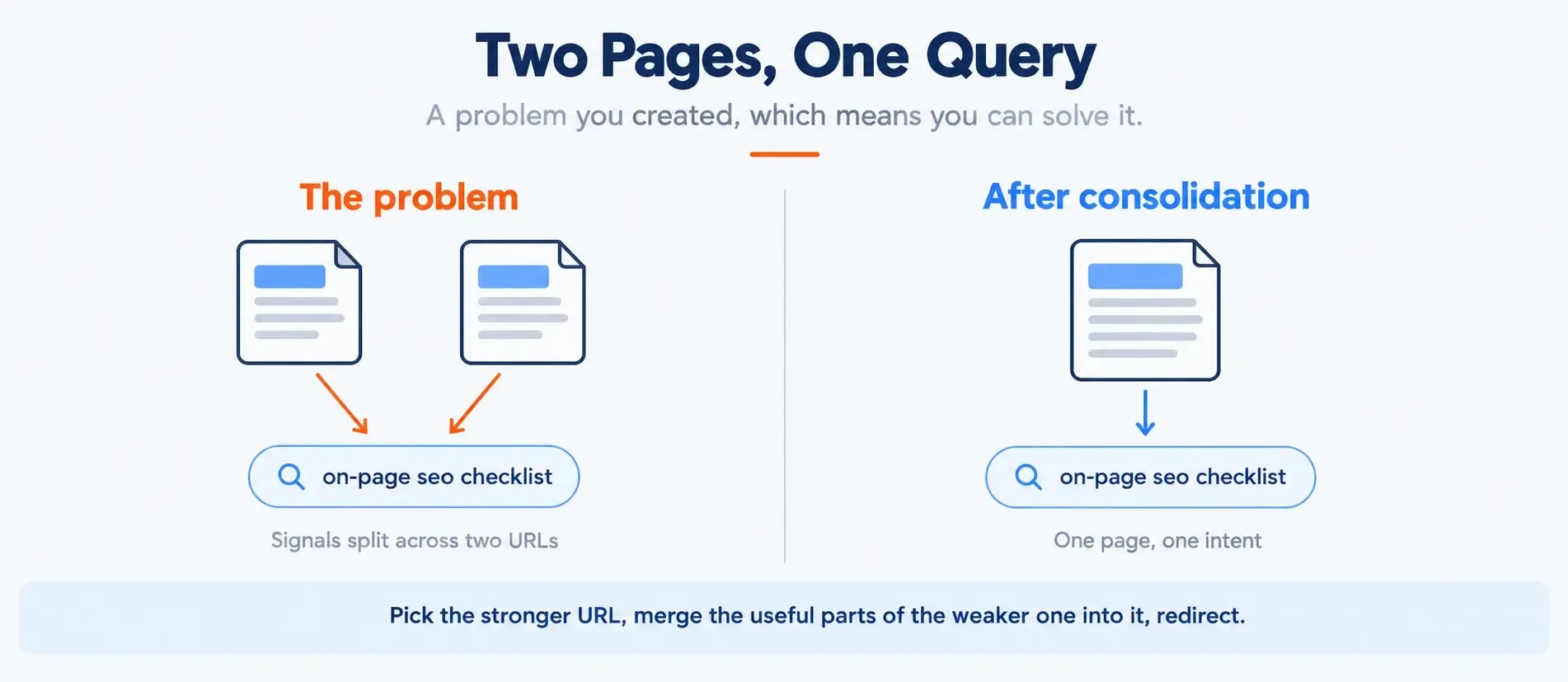
Filter Search Console by the query, open the Pages tab, and look for a second URL. The usual fix is to pick the stronger page, merge the useful parts of the weaker one, and redirect.
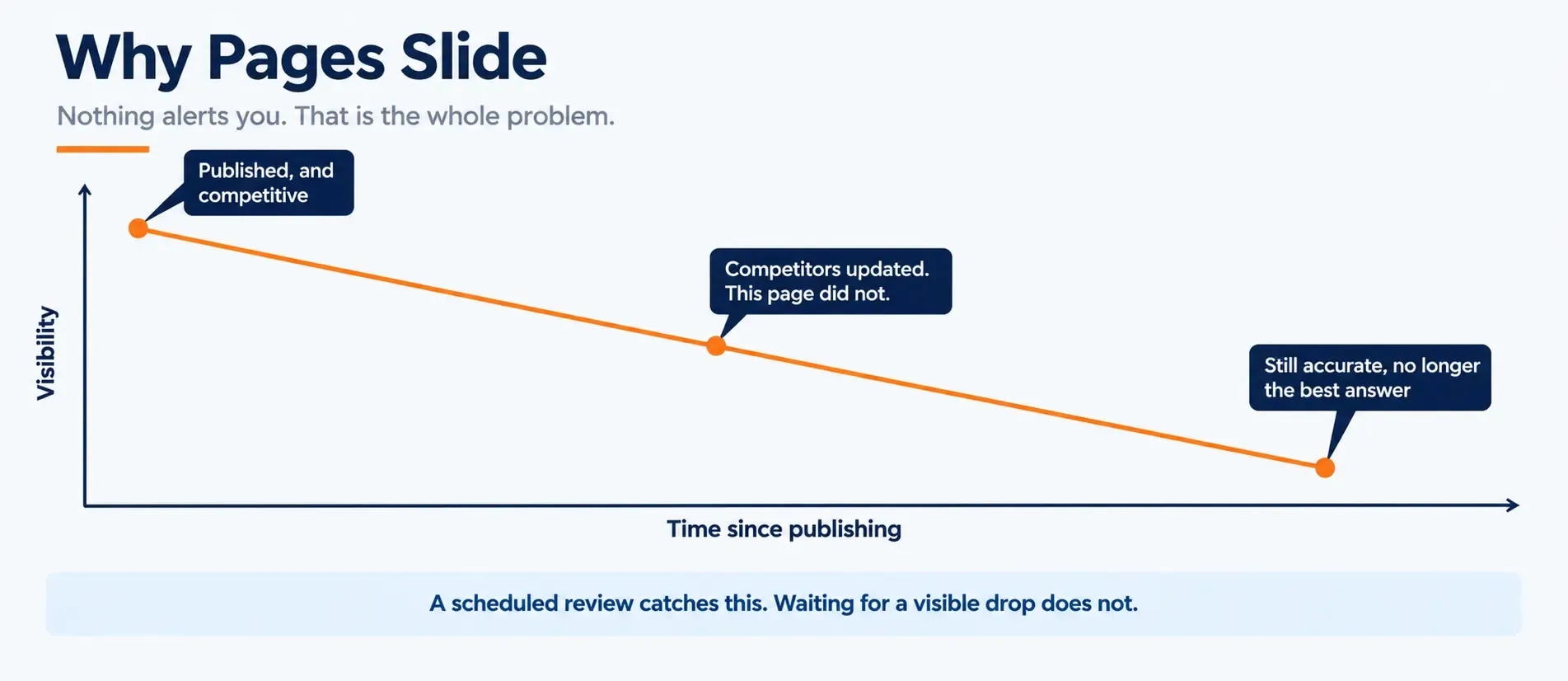
18. Content decay
Pages decline quietly. Compare important pages with the same period last year each quarter. A content audit formalizes this.
19. Passage clarity
Google can rank a specific passage, but it still indexes the page as a whole. Write sections that make sense on their own, and define terms right after the heading that introduces them.
What to do when a page ranks but not well enough
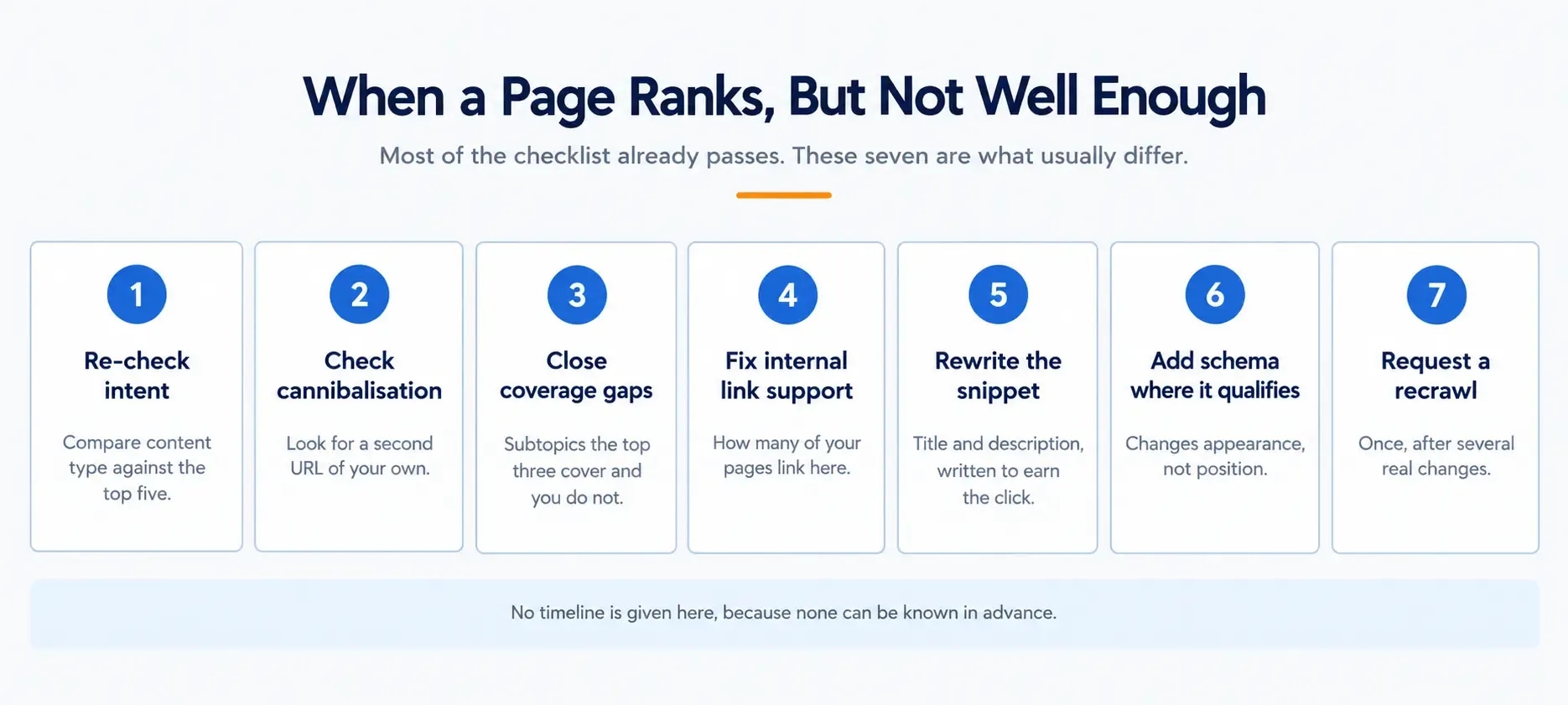
Running the whole on-page SEO checklist again is usually wasted effort for a page in positions 8 to 20, because most of it already passes. Use this shorter sequence:
- Re-check intent against the top five.
- Look for a second URL of yours on the query.
- Close real coverage gaps.
- Add internal links from relevant pages.
- Rewrite the title and description to earn the click.
- Add schema where it qualifies.
- Request a recrawl once, after several real changes.
Nobody can honestly give you a timeline. Record the date of each change, and compare over a window long enough to survive normal swings.
On-page SEO and AI features
Google says "You don't need to create new machine readable files, AI text files, markup, or Markdown to appear in Google Search" [3]. It also says you can ignore tactics like chunking content [3].
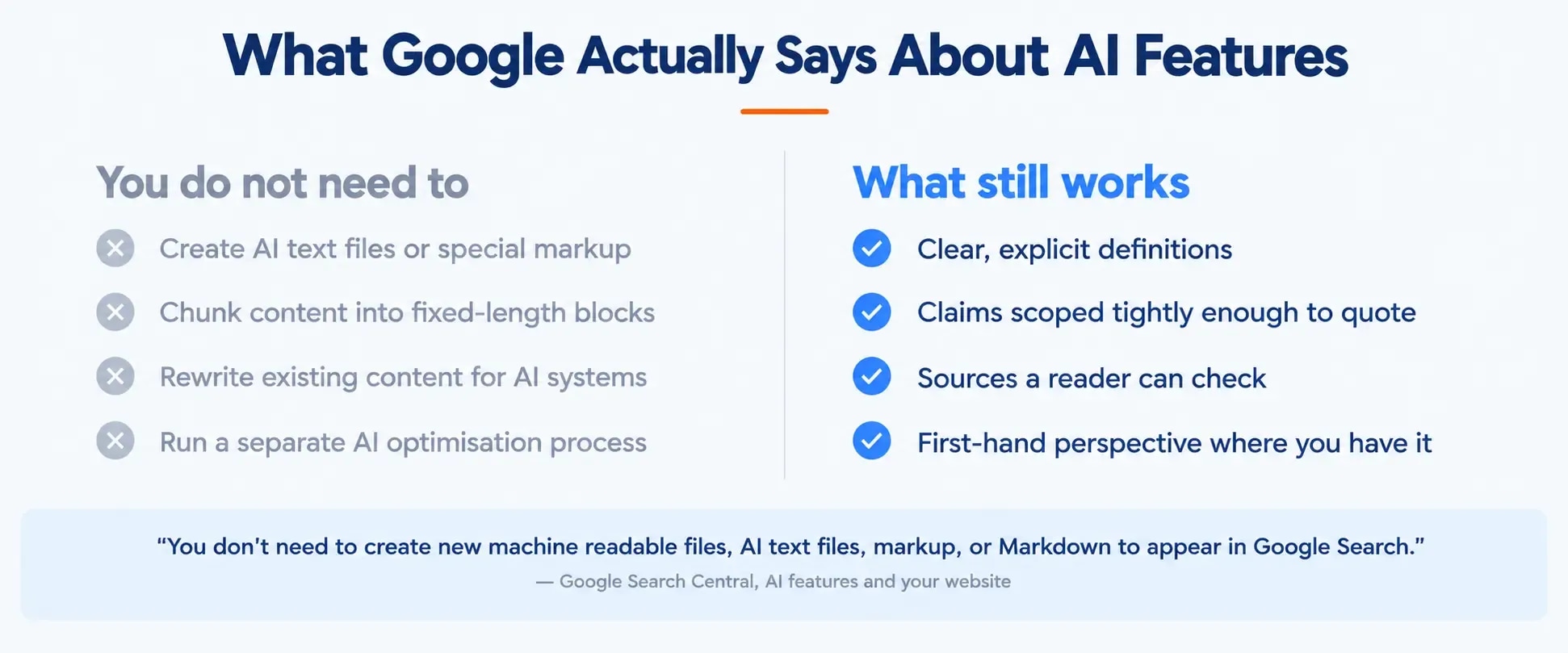
Clear writing, explicit definitions and sources a reader can check serve people and AI features alike. For more, see how AI Overviews work and SEO vs GEO vs AEO.
What E-E-A-T is, and what it is not
E-E-A-T stands for experience, expertise, authoritativeness and trustworthiness. Google's SEO Starter Guide lists thinking it is a ranking factor as a mistake [1]. There is no score to raise. Treat it as a content standard: a named author, visible dates, linked sources, and specifics in place of generalities.
Common mistakes
- Working top to bottom. Schema on a page with an intent mismatch is wasted effort.
- Stopping at a clean audit. Anobee's articles passed almost everything, and this one still sits near position 84.
- Ignoring inbound links. Eleven of our own articles had none from another article.
- Optimizing for density. Repetition is not coverage.
- Treating a title rewrite as a penalty. It is feedback.
- Marking up hidden content. Structured data must match what readers see.
- Publishing and walking away. Decay is the default.
Start with intent and indexability. Earn the title. Then check who links to the page, because that was the one on-page SEO checklist item our own site failed. Markup and milliseconds can wait.
Frequently Asked Questions
What should an on-page SEO checklist include?
Search intent, indexability, title tag, H1 and opening, internal links, content depth, headings, images, external sources, meta description, URL, schema, Core Web Vitals, mobile rendering, cannibalization and content decay. It is distinct from off-page SEO, which is mostly links and mentions from other sites.
What should I fix first on a page that is not ranking?
Check intent first. Search the keyword and compare the content type of the top results with your page. If they are comparison posts and yours is a landing page, title or schema work will not fix it. After that, confirm the page is indexable and that its title is honest.
Is keyword density still worth tracking?
No. Google reads meaning, so a page that covers related concepts is clearly about the subject even when the exact phrase appears only a few times. Coverage of the topic matters more than repetition of the phrase.
Does page speed affect rankings?
Core Web Vitals are used by Google's ranking systems, but Google says there is no single page experience signal, and that Search still aims to show the most relevant content when page experience is poor. Treat speed as real but secondary to intent.
Is E-E-A-T a ranking factor?
Google's SEO Starter Guide says it is not. Treat it as a standard for trustworthy content, such as named authors, dates and cited sources, not as a score you can raise.
How many internal links should a page have?
Google says there is no ideal number, and that if it looks like too many, it probably is. The more useful question is how many relevant pages link to the page you care about.
Sources and References
Was this guide helpful?
Your answer helps Anobee improve future updates.

Written by
Bibek Thapa
AI-Powered Digital Growth Strategist
Bibek Thapa works across AI workflows, SEO, AI search optimization, content strategy, website growth, and productivity systems at Anobee.
- AI workflows
- Digital growth
- SEO
- GEO
- AEO
- Content strategy
- Website growth