Content & Marketing
What Is Digital Marketing? The 9 Channels, and How to Choose One
By Bibek Thapa · Updated · 16 min read
Quick Answer
Digital marketing is the promotion of products, services or brands through digital channels and internet-connected devices. It covers search results, paid ads, email, social media, video and apps. There are nine channels in common use, and they differ in cost, speed and what they can prove. The practical question is not which channel is best, but which one your audience already uses.
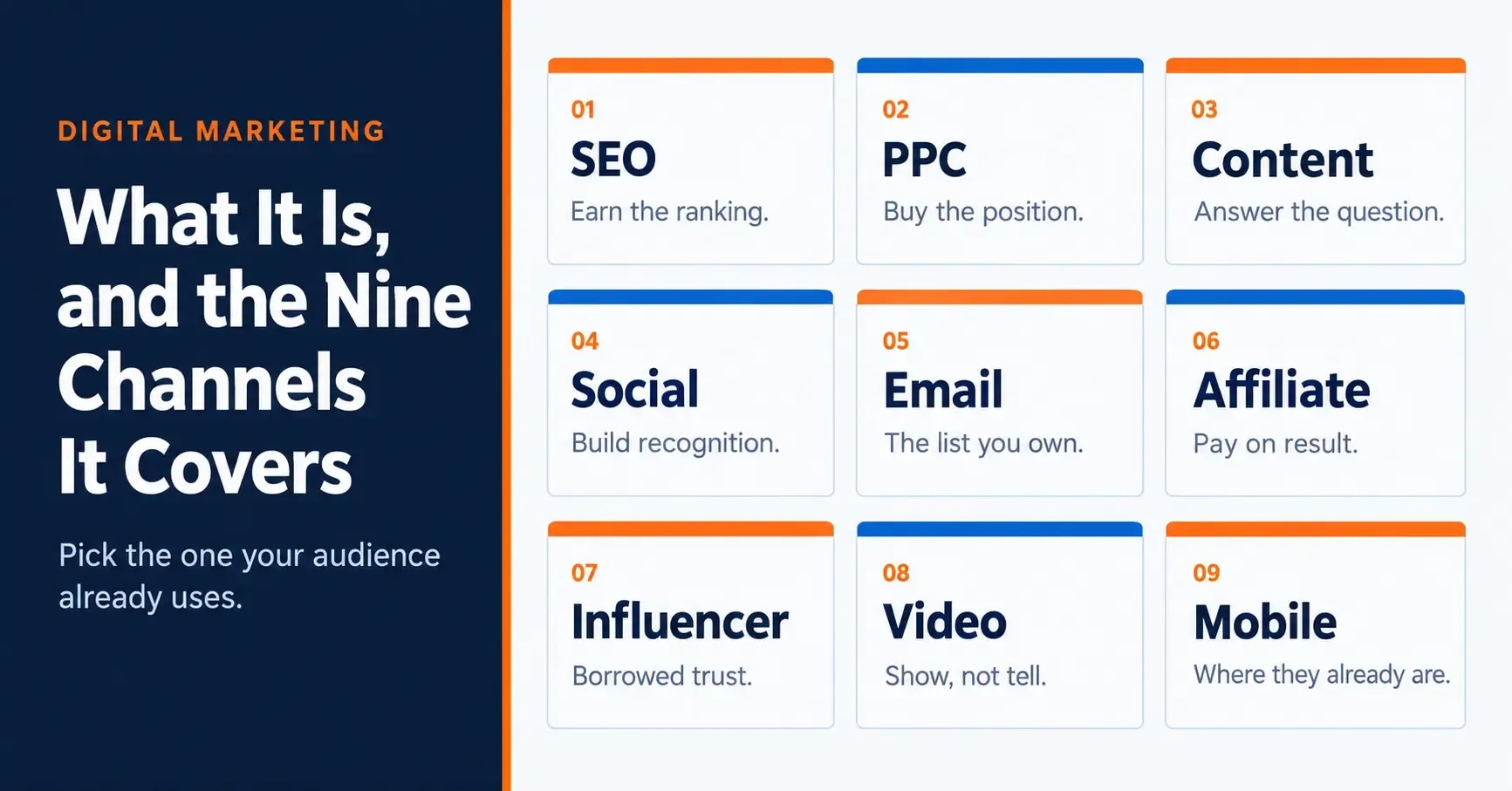
Table of ContentsOn this page
- What digital marketing means
- How digital marketing works
- The digital marketing funnel
- The 9 types of digital marketing
- Digital marketing channels compared
- How to choose your first channel
- SEO vs PPC vs social media marketing
- Digital marketing vs traditional marketing
- What digital marketing gives a small operator
- A worked example
- Common digital marketing mistakes
- The tools worth starting with
- How to start digital marketing as a beginner
- Careers in digital marketing
- Digital marketing and AI
- The bottom line
- Frequently Asked Questions
- Sources and References
Key Takeaways
- Digital marketing is any marketing that reaches people through the internet or an electronic device.
- The nine channels in common use are SEO, PPC, content, social, email, affiliate, influencer, video and mobile.
- Channels differ most in time to first result. Paid ads can run today; SEO and content compound over months.
- Google reversed the removal of third-party cookies in Chrome, so first-party data is valuable but cookies remain.
- Bulk senders to Gmail need SPF, DKIM and DMARC, spam rates under 0.30%, and one-click unsubscribe.
- The FTC requires a clear and conspicuous disclosure in every paid post, not once on a profile page.
- Statcounter put mobile at 58.99% of worldwide web traffic in September 2026, so mobile is the majority case.
Most guides to digital marketing list the channels and stop there. That leaves the reader with the only question that actually matters still unanswered: which one to start with, and why.
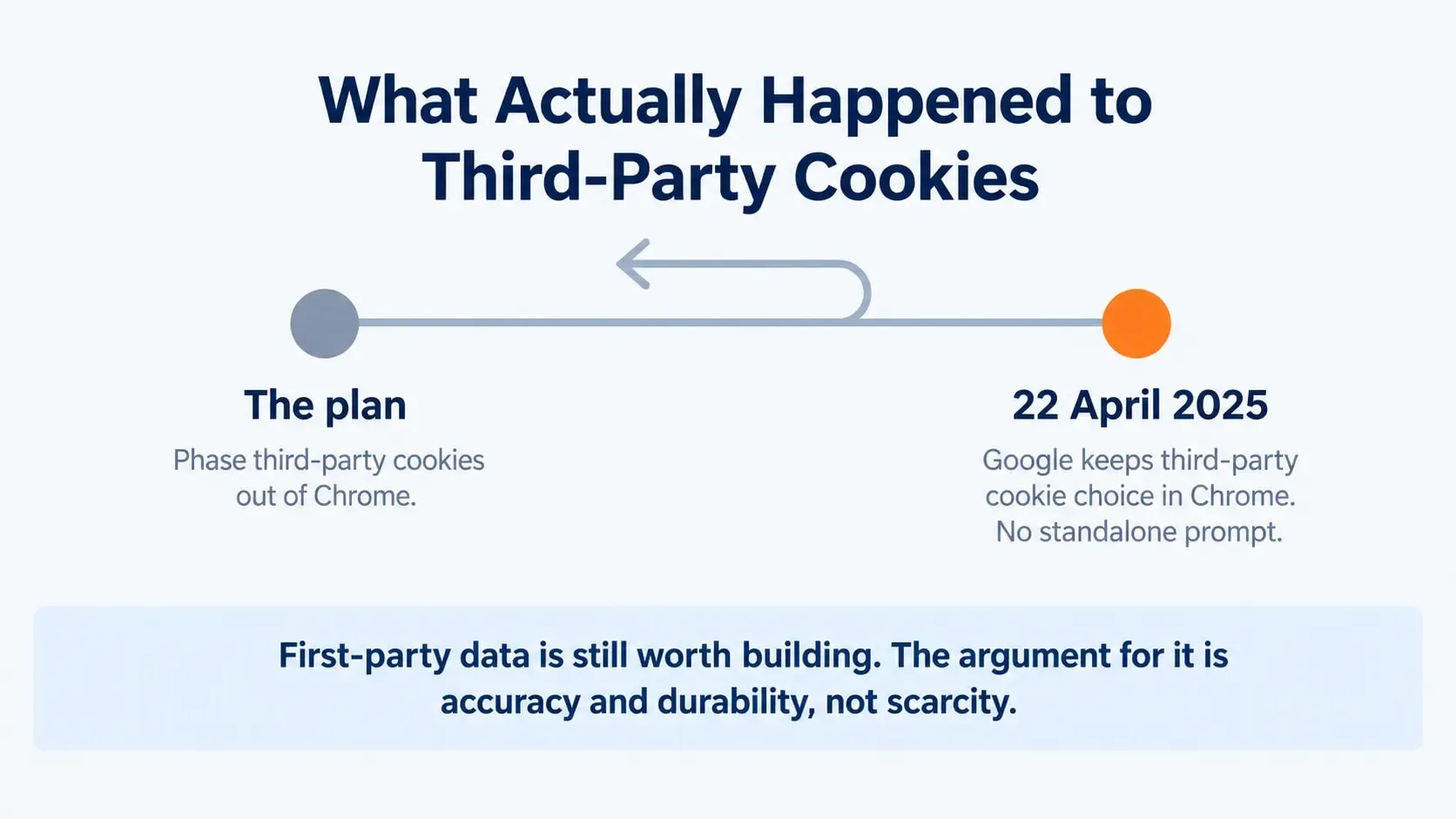
This version answers it, and corrects something the previous version got wrong. The page claimed that third-party cookies had been phased out. They have not been. Google reversed that plan on 22 April 2025, saying it would "maintain our current approach to offering users third-party cookie choice in Chrome" and would "not be rolling out a new standalone prompt for third-party cookies" [1]. First-party data is still worth building. It is not worth building because the alternative disappeared.
Two sections of the previous version were also listed in the table of contents while containing nothing at all. Both are now written, and the channel comparison is a table rather than a picture, so the comparison can be read, quoted and searched.
What digital marketing means
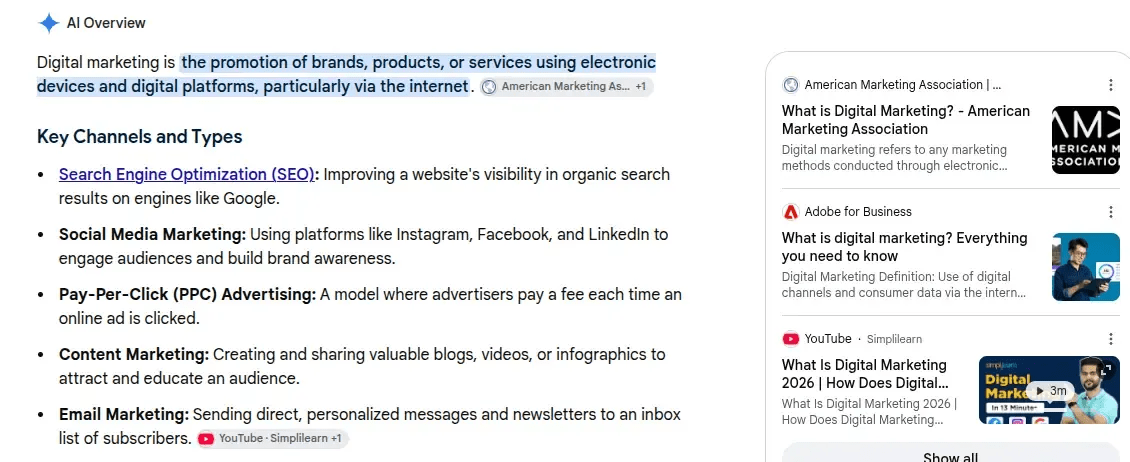
Digital marketing is any marketing effort that uses the internet or an electronic device. That is the whole definition. It covers appearing in Google Search results, running ads on Instagram, sending an email newsletter, publishing a guide, and uploading a video.
The useful distinction is not digital versus physical, but measurable versus not. A printed flyer goes out and you infer the result. A digital campaign reports who clicked, what they did next, and what it cost, while the campaign is still running. That is why digital marketing can be corrected mid-flight and traditional marketing largely cannot.
Scale explains why it is no longer optional. The ITU estimates that approximately 6 billion people, or 74 per cent of the world's population, were using the internet in 2025 [4]. The people who would buy from you are almost certainly among them.
How digital marketing works
Someone finds you, forms an impression, and either continues or leaves. A small share hand over an email address or a card. A smaller share come back. Everything else in this guide is machinery built around that sequence.
The machinery is worth understanding mainly because each stage is tracked somewhere different, which is why measurement gets messy fast. Site behaviour sits in analytics. Contacts sit in an email tool or a CRM. Ad platforms report their own version of events, usually the most flattering one. Before trusting any of it, it is worth knowing what your analytics can and cannot attribute, which the content ROI framework covers properly.
The digital marketing funnel
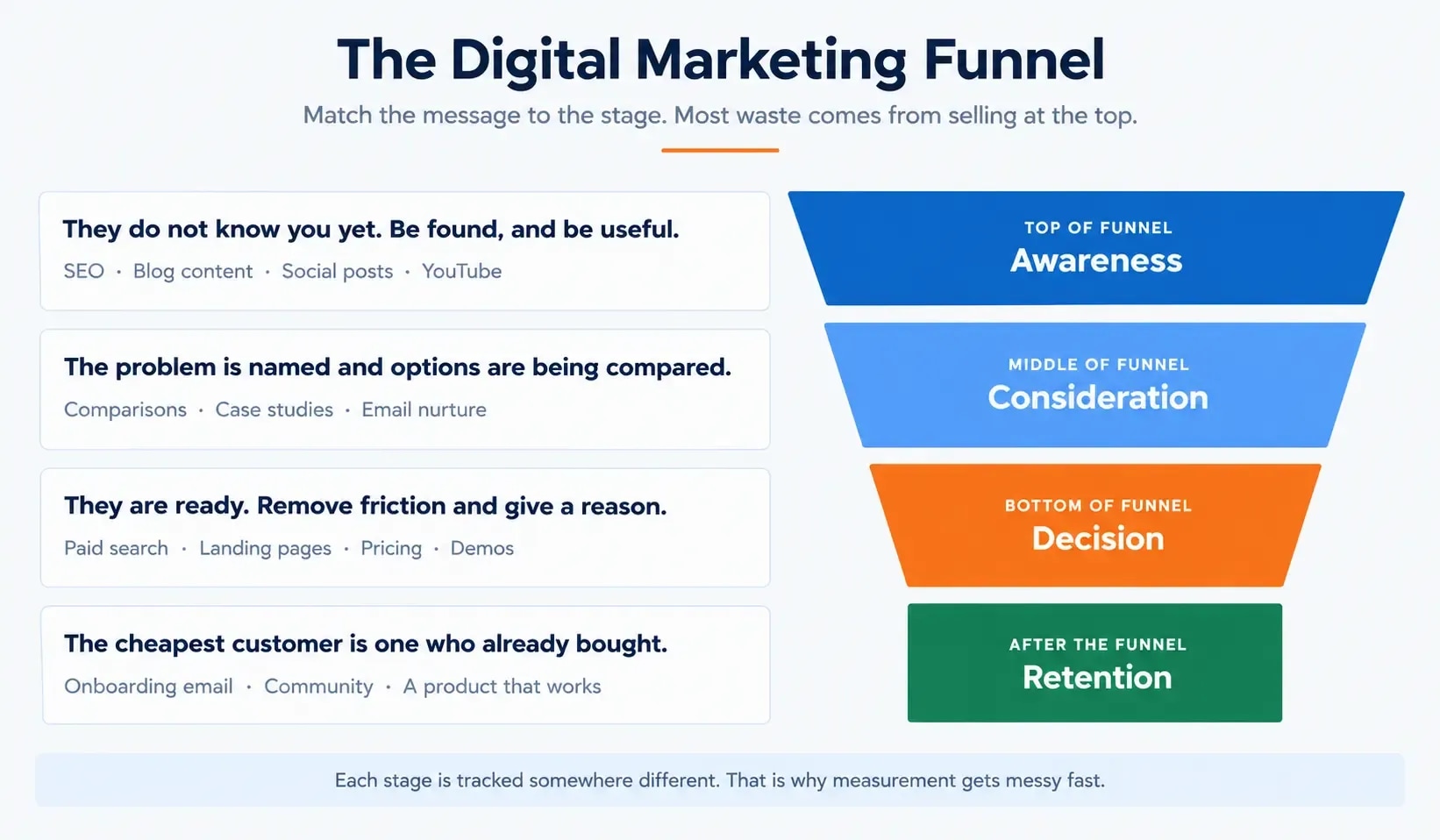
The funnel names those stages so you can tell which one a person is in. It exists to prevent one specific mistake: selling to people who are not yet looking to buy.
Top of funnel, awareness. The person does not know you and may not have named their problem yet. The job is to be found and to be useful. Blog content, organic search, social posts and video belong here. The content looks like "what is a digital marketing channel", not "book a call".
Middle of funnel, consideration. The problem is named and options are being compared. The job is to earn trust. Comparison articles, case studies, email sequences and webinars belong here.
Bottom of funnel, decision. The person is ready and is looking for a reason to pick you, or a reason not to. The job is to remove friction. Landing pages, paid search on commercial queries, pricing clarity, demos and trials belong here.
After the funnel, retention. The cheapest customer to reach is one who already bought. Email, community and a product that works belong here.
Matching content to stage is the same discipline as matching content to search intent. If that mapping is unfamiliar, the search intent analysis guide sets out how to read what a query is actually asking for.
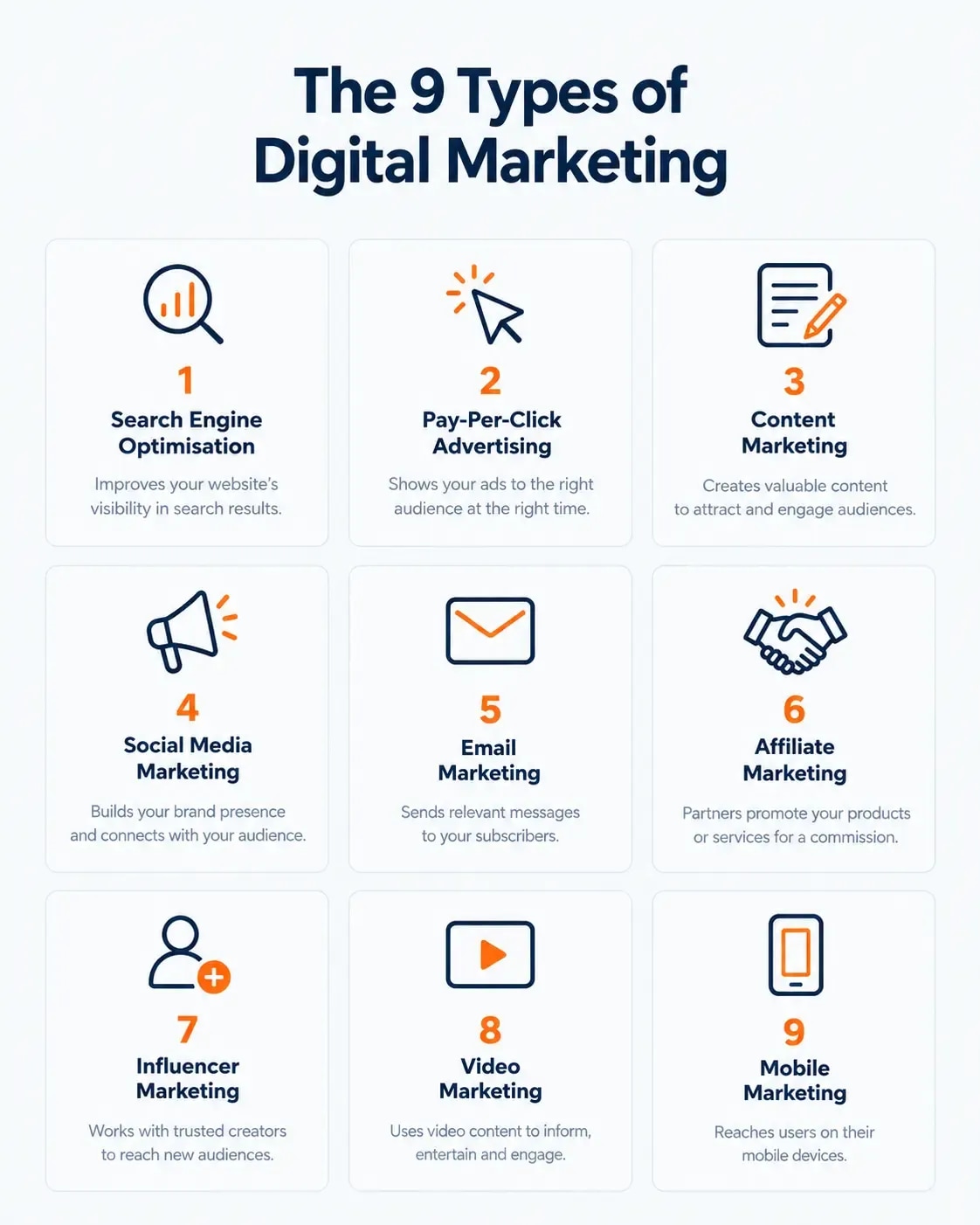
The 9 types of digital marketing
Search engine optimisation (SEO)
SEO is the practice of making a site easier for search engines to find, understand and rank, so that it appears for the queries its audience types.
It has three working parts. Technical SEO covers crawling, indexing, site speed and mobile rendering. On-page SEO covers what a page says and how clearly it says it: titles, headings, internal links and content that matches the query. Off-page SEO covers the signals that come from elsewhere, mainly links and mentions from other sites.
A note on that last one. Off-page SEO is often described as building "domain authority", which is a third-party metric invented by an SEO tool vendor. It is a useful shorthand for estimating competitiveness. It is not a figure Google publishes or uses, and treating it as a target rather than an estimate leads to bad decisions.
SEO is the slowest channel and the one that keeps paying. A page that ranks can keep earning visits for years at no extra cost per click. The trade is patience: new pages need to be crawled, indexed and judged before any of that starts.
Tools: Google Search Console, Google Analytics, and one keyword tool. Start with the complete on-page SEO checklist, and if a site already exists, rule out the technical SEO mistakes that quietly cap everything else.
Pay-per-click advertising (PPC)
PPC is paid advertising where you are charged each time someone clicks. Google Ads is the dominant platform for paid search, placing ads against queries you bid on.
PPC buys what SEO earns, and the difference is speed. A campaign can be live today and sending traffic tomorrow. The cost is that it stops the moment you stop paying.
Three numbers run the channel. Cost per click is what you pay for a visit. Quality Score is Google's own rating of how relevant the ad and landing page are, and a better score lowers what you pay for the same position. Return on ad spend is revenue divided by advertising cost, and it is the only one of the three that tells you whether to continue.
PPC is also the fastest way to test an offer. If paid traffic will not convert at any price, the problem is usually the offer or the page, not the channel, and the conversion rate optimisation guide is the better place to spend the next hour.
Content marketing
Content marketing is the creation and distribution of useful material to attract and keep a defined audience, without pitching directly.
It runs on a simple exchange: help first, sell later. Published answers to real questions earn attention that advertising has to rent.
Content is also the channel the other channels depend on. SEO needs pages to rank, email needs something to send, and social needs something to post. Starting anywhere else usually means producing content anyway, just with less control over it. Once a library exists, a content audit is what keeps it earning, and topical authority is what turns scattered posts into coverage of a subject.
Social media marketing
Social media marketing uses platforms such as Instagram, Facebook, LinkedIn, TikTok, X and Pinterest to build recognition, hold attention and move people toward a site or an offer.
It has two modes that behave nothing alike. Organic social is free to post and increasingly expensive in effort, because reach depends on an algorithm you do not control. Paid social is predictable and immediate, because you are buying placement rather than hoping for it.
Platform choice follows the audience, not the trend. LinkedIn suits business-to-business and professional services. Instagram and TikTok suit visual and short-form categories. YouTube behaves partly like a search engine, which makes it the most durable of the set. Pinterest behaves like visual search and converts well for products people plan around.
Social is strongest at the top of the funnel and weakest as a direct sales channel, which is why measuring it on last-click revenue makes it look worse than it is. The social media marketing guide sets out a strategy that can actually be checked.
Email marketing
Email marketing is sending messages to people who asked to hear from you, then measuring what they do next.
What makes it different from every other channel is ownership. An email list is a direct line that no algorithm sits in front of and no platform can reprice. That is the entire argument for it.
Email is also the channel with the most explicit rules, and they are published. For senders of 5,000 or more messages a day to Gmail, Google requires SPF and DKIM authentication, DMARC on the sending domain, spam rates reported in Postmaster Tools kept "below 0.30%", and one-click unsubscribe support with "a clearly visible unsubscribe link in the message body" [5]. These are conditions of delivery, not best practice.
The flows worth building first are a welcome sequence, a nurture sequence, an abandoned cart email for retail, and a re-engagement campaign. Tools: Mailchimp, Kit, ActiveCampaign, Klaviyo or Brevo. Note that Kit is the tool many guides still call ConvertKit, which was its name until 2024. For what to send and how to reach the inbox, see the email marketing guide for beginners; for getting subscribers in the first place, the email list building guide.
Affiliate marketing
Affiliate marketing pays partners a commission for sales or leads they generate. The merchant pays only on a result, which makes it the lowest-risk paid channel to run. The affiliate earns by recommending products to an audience that already trusts them.
Amazon Associates, ShareASale and Impact are among the larger networks, and many software companies run programmes directly. Commission is only half the decision, though. A programme with a short cookie window or a long payout delay can pay less in practice than a lower headline rate, which is the sort of detail the affiliate marketing guide gets into.
Disclosure is not optional. The FTC requires that a material connection be disclosed "clearly and conspicuously", in each individual post rather than once on a profile page [6].
Influencer marketing
Influencer marketing pays someone with an established audience to present your product to it. It works because a recommendation from a familiar person carries trust that an advertisement cannot buy directly.
The tiers are conventionally nano (1,000 to 10,000 followers), micro (10,000 to 100,000), macro (100,000 to 1 million) and mega (above 1 million). Smaller accounts tend to have more engaged and more specific audiences, and they cost far less, which is why a set of micro partnerships often outperforms one large one. Treat that as a widely reported pattern rather than a rule, because it depends heavily on the category and on who was chosen.
The same FTC disclosure requirement applies, and it applies to the brand as well as to the creator [6].
Video marketing
Video is the format that builds familiarity fastest, because tone and competence come through in a way text cannot carry. It demonstrates a product in use, and it answers questions where watching beats reading.
YouTube is the one to understand properly. It is a platform where people search rather than scroll, which means a video can keep earning views long after it is published, in the way a ranking page does. Short-form video on Reels, TikTok and Shorts works differently: enormous reach, very little durability.
One claim to drop here. Video is often said to improve rankings by increasing time on page. Google does not publish engagement time as a ranking signal, and building a video strategy on that premise is building on an assumption. Make videos because they answer the question better, which is reason enough.
A phone, decent light and a quiet room clear the bar on most platforms, where unpolished often outperforms produced.
Mobile marketing
Mobile marketing is any effort aimed at people on phones and tablets, which is now the majority case rather than a special case. Statcounter put mobile at 58.99% of worldwide web traffic in September 2026, against 39.26% for desktop and 1.76% for tablets [3].
The channels are mobile-optimised pages, SMS and WhatsApp, push notifications, in-app advertising, and app store optimisation.
What this mostly means in practice is that mobile is the default design target. Google indexes the mobile version of a page, so content that does not render on a phone is content Google may not see.
Digital marketing channels compared
Channels are not interchangeable, and the differences that matter are rarely the ones listed in a features table. These four are.
| Channel | Cost to start | Time to first result | What it proves | Best fit |
|---|---|---|---|---|
| SEO | Low in money, high in time | Months | Demand exists and you can be found for it | Durable traffic; answers people search for |
| PPC | Whatever you set, spent immediately | Days | Whether the offer converts, and at what price | Testing demand fast; commercial queries |
| Content | Low in money, high in time | Months | That you know the subject | Trust at scale; feeding every other channel |
| Social organic | Free to post, costly in effort | Weeks | That the audience is reachable and listening | Recognition; categories with visual appeal |
| Social paid | Whatever you set | Days | Whether targeting assumptions are correct | Reaching a defined audience with no search demand |
| Low, after a list exists | Immediate, once a list exists | Whether people act on what you send | Repeat business; the channel you own outright | |
| Affiliate | Nothing until a sale occurs | Weeks to months | That the product sells when recommended | Products with clear margin and broad appeal |
| Influencer | Fee paid upfront | Days to weeks | That borrowed trust transfers | Visual and lifestyle categories |
| Video | Low in money, high in effort | Weeks to months | That you can explain it well | Demonstrations; subjects easier to show |
| Mobile | Varies by tactic | Varies | Whether the experience works where people are | Everything, as a constraint rather than a channel |
Two honest caveats. The time and cost columns are editorial judgements about how each channel works, not measured averages, and your results will depend on your market and offer. And "what it proves" is the column worth re-reading, because channels are most useful when chosen for the question they can answer.
How to choose your first channel
Three questions settle it, in this order.
Where is the audience already looking? People who type their problem into Google are reachable through search and content. People who discover things by scrolling are reachable through social and video. A harder audience, one that ignores both but responds when contacted directly, belongs to email. Guessing at this question is the expensive mistake, and it is the one most often guessed at.
Do you have more time or more money? With time and little budget, content plus SEO builds an asset you keep. With a budget and a working offer, paid search tells you in a week what SEO takes months to reveal. Having neither is a reason to wait, not a reason to spread both thin.
Can you sustain it for six months? This is the question that actually decides outcomes. A channel run inconsistently produces nothing, regardless of which one it is. Pick the one you can still be doing in six months.
Then run one channel properly before adding a second. Most businesses that struggle with digital marketing are not running the wrong channel. They are running five channels at a fifth of the required effort each.
SEO vs PPC vs social media marketing
These three get compared constantly, usually as though one has to win. They answer different questions.
SEO captures demand that already exists. Someone is searching for what you offer, and the work is being the best answer. It is slow, it compounds, and it is the cheapest traffic you will ever get once it arrives. It is also the most vulnerable to things outside your control, including changes in how search results are presented.
PPC also captures existing demand, but buys the position instead of earning it. It is immediate, controllable and honest about cost, because you see exactly what a customer costs. It stops when the budget does.
Social media mostly creates demand rather than capturing it. People were not looking for you, and now they know you exist. That makes it strong for recognition and weak for immediate return, and it is why judging social on last-click revenue consistently undersells it.
The practical combination is not all three at once, but PPC to learn and SEO to keep. Paid search reveals which queries convert and what a customer is worth, within weeks. That knowledge tells you which pages are worth the months SEO requires. Social then amplifies whatever is already working.
Digital marketing vs traditional marketing
Traditional marketing reaches people through physical and broadcast channels: print, television, radio, billboards, direct mail. Digital marketing reaches them through the internet. The real differences are four.
Targeting. Traditional channels buy an audience by proxy, through the programme or publication someone chose. Digital channels target by location, interest, behaviour and search query, which means less waste and a much smaller minimum viable budget.
Measurement. A billboard is measured by inference. A digital campaign reports clicks, conversions and cost per result, although the attribution is less certain than dashboards imply.
Speed of correction. A printed run cannot be changed. A campaign that is not working can be paused this afternoon.
Cost structure. Traditional marketing is mostly rented: the moment the spend stops, the visibility stops. Digital includes both rented channels, such as advertising, and owned ones, such as a ranking page or an email list, which keep working after the work stops.
None of this makes traditional marketing obsolete. It makes it a different instrument, better at mass awareness in a defined place and worse at everything that requires precision or proof.
What digital marketing gives a small operator
The targeting and measurement advantages above apply to everyone. Three things matter specifically if you are small.
- A smaller entry cost. Organic channels cost effort rather than media spend, and paid channels can be tested at a few dollars a day. There is no minimum buy.
- Assets that compound. A ranking page and a subscriber list keep producing after the work stops. Advertising does not, which is why a small budget spent on owned channels outlasts the same budget spent on rented ones.
- Personalisation without a team. Segmented email and basic CRM data let one person send relevant messages to thousands.
Relevance and consistency are available to anyone. Media budgets are not, and that is the gap a small operator is actually exploiting.
A worked example
The following is an illustration, not a case study. The company does not exist and the numbers are arithmetic chosen to show how the stages connect, not results anyone achieved.
Imagine a project management tool. It publishes a guide to managing remote teams, which eventually ranks and brings in organic visits each month. The guide offers a template in exchange for an email address, and a share of readers take it. Those subscribers receive a short sequence that explains the problem properly before mentioning the product. Readers who did not subscribe see retargeted ads offering a trial. Trial users get onboarding emails, and some convert to paid. Customers receive product updates that keep them active.
The point is the structure. Each stage works only because the one before it did, and a weak link anywhere caps everything after it. Most funnels break at the second step, where traffic arrives and nothing invites the visitor to continue.
Real numbers come from measuring your own version. What a channel is worth is specific to your offer, price and market, and any guide quoting a universal conversion rate is quoting something it cannot know.
Common digital marketing mistakes
- Starting without deciding who it is for. "Everyone" is not an audience, and a message aimed at everyone persuades nobody.
- Running five channels badly. Attention divided five ways produces five mediocre efforts. Pick one, make it work, then add.
- Treating mobile as secondary. With mobile at roughly 59% of web traffic [3], a layout that only works on a laptop fails most visitors.
- Keeping channels in separate boxes. Content feeds SEO, SEO feeds email, email feeds repeat sales. Run separately, each is weaker.
- Never building a list. Platforms change their rules and their prices. A list is the only audience that stays yours. The content distribution checklist is a good place to start fixing this.
- Reporting on followers and pageviews. They are easy to grow and easy to mistake for progress. Leads, sales and retention are harder and real.
- Stopping at month four. SEO and content are slow by nature. Most people quit during the period where nothing visible is happening and everything necessary is.
- Buying traffic to a page that does not convert. Doubling conversion doubles revenue without a single extra visit, and it is usually the cheaper problem to fix.
The tools worth starting with
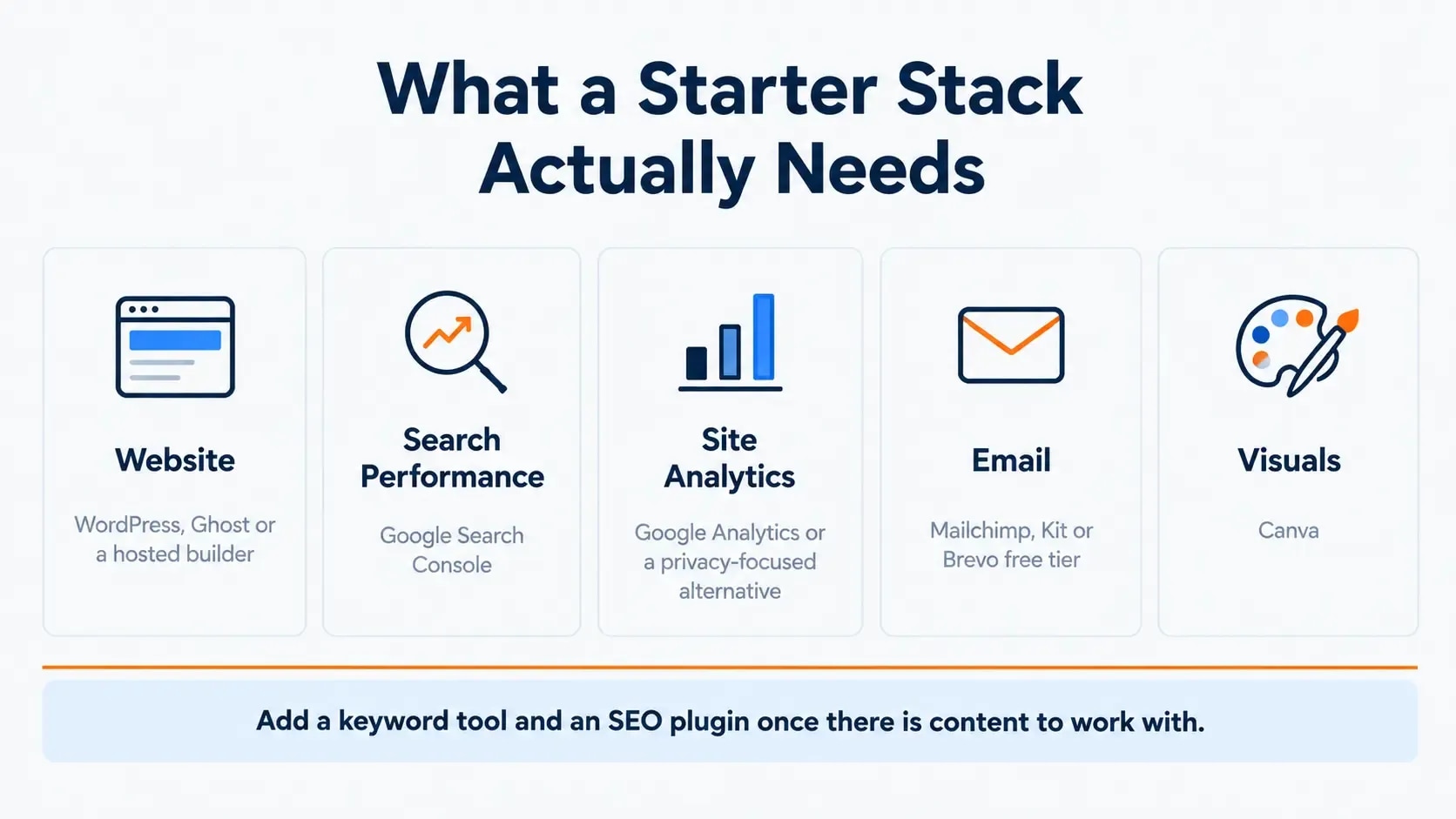
The list of marketing tools is effectively infinite and mostly irrelevant to a beginner. A starting stack needs five jobs covered: a site, analytics, search data, email, and something to make images with.
| Job | Free or low-cost option | Why it is needed |
|---|---|---|
| Website | WordPress, Ghost, or a hosted builder | Somewhere you own and control |
| Search performance | Google Search Console | The only free source of real query data |
| Site analytics | Google Analytics, or a privacy-focused alternative | What people do once they arrive |
| Mailchimp, Kit or Brevo free tier | The audience you keep | |
| Visuals | Canva | Images without a designer |
Add a keyword tool and an SEO plugin once there is content to work with. For setting analytics up properly rather than approximately, see the Google Analytics setup guide, and for choosing a keyword tool, the keyword research tools comparison.
Paid tools are worth buying when a specific job is costing real time, not before.
How to start digital marketing as a beginner
A realistic first year, assuming a few hours a week.
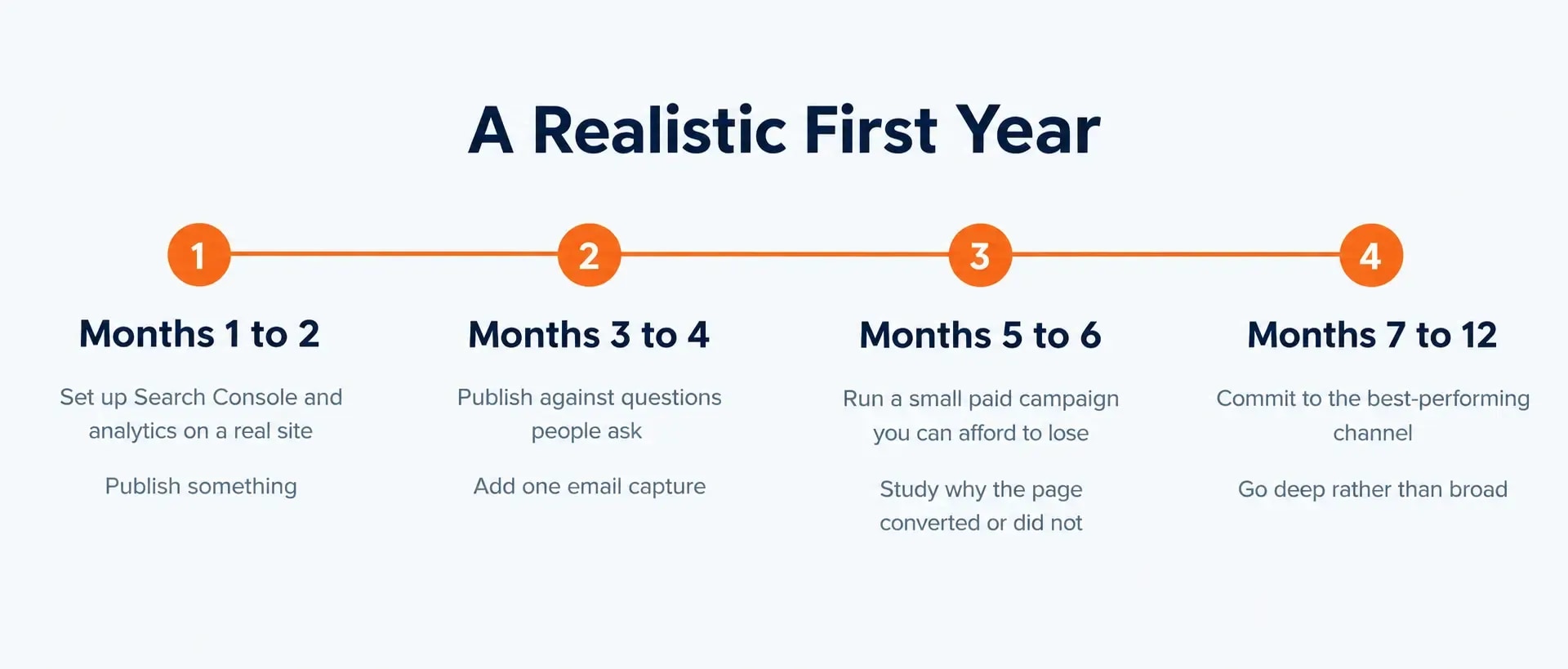
Months one and two. Learn how search works, set up Search Console and analytics on a real site, and publish something. A site with three pages and working measurement teaches more than a course.
Months three and four. Publish consistently against questions people actually ask, and add one email capture. Ten useful pages beat forty thin ones.
Months five and six. Run a small paid campaign, at a budget you can afford to lose, to learn what converting traffic feels like. Then study why the page converted or did not.
Months seven to twelve. Commit to whichever channel produced the most for the effort, and go deep. Breadth is for later.
Free learning worth the time: Grow with Google for fundamentals, Google Skillshop for the ad and analytics certifications, HubSpot Academy for inbound and email, and Google's own Search Central documentation, which is the primary source most SEO content is paraphrasing. Note that Google Digital Garage, recommended in older guides including a previous version of this one, has been retired and now redirects to Grow with Google.
Careers in digital marketing
Digital marketing stays unusually open as a field for one structural reason: the work is visible. A page that ranks, a campaign that returned a profit, a list that grew, any of these can be shown to an employer without a credential in front of them. Certifications demonstrate familiarity. A portfolio demonstrates competence, and the usual way to build one without a job is to do the work on your own site.
Specialisation matters more than people expect. "Digital marketer" describes someone who can do a little of nine things, while SEO specialist, paid search manager and lifecycle marketer describe people who get hired.
Salary and demand figures circulate widely and vary enormously by country. This guide cannot verify them for your market, so treat any single number you see as a claim rather than a fact.
Digital marketing and AI
AI has changed how marketing work gets done, and it has changed the surface that marketing competes on. Both matter, and they are often confused.
Making the work. Language models draft, summarise, repurpose and translate faster than a person can. What they do not supply is a reason for a page to exist. Google retired the separate helpful content system in March 2024, when "it evolved and became part of our core ranking systems" [2]. The standard did not relax. It stopped being something you could treat as a separate hurdle.
The search surface. AI Overviews and assistant answers mean a question can be resolved without a click. That changes what organic traffic is worth and what sort of page earns a citation. Clear definitions, specific numbers, visible sources and well-scoped claims are what gets quoted. The mechanics are covered in how Google AI Overviews work, and the discipline of optimising for answer engines in SEO vs GEO vs AEO.
Inside the ad platforms. Automated bidding and creative testing now outperform manual campaign management for most advertisers, which has shifted the skill from operating the platform to feeding it good inputs: accurate conversion data, a clear audience and an offer worth running.
And the data question. This is where the previous version of this guide was wrong. Third-party cookies were not removed from Chrome. Google chose in April 2025 to keep offering users a cookie choice rather than roll out a standalone prompt [1]. The argument for first-party data stands on its own merits, because data you collected is more accurate and more durable than data you rented. It no longer stands on the claim that nothing else is available.
What has not changed is the part people hope will. Knowing who you are talking to, having something worth saying, and saying it consistently are still the whole job. AI shortens execution, not judgement.
The bottom line
Digital marketing is not a tactic but a set of nine channels, each with its own cost, speed and limits. The nine are worth knowing. Running all nine is not worth attempting.
Start where the audience already looks. Pick based on whether you have more time or more money. Then stay with it long enough to learn something, which is longer than most people allow and shorter than the field makes it sound.
Frequently Asked Questions
What is digital marketing in simple words?
Digital marketing is promoting a business online through search engines, social media, email, websites and apps, to reach people, build recognition and sell. If the message travels over the internet or reaches someone on an electronic device, it is digital marketing.
What is a digital marketing channel?
A digital marketing channel is a specific route a message travels to reach an audience online, such as organic search, paid search, email or short-form video. Channels are not interchangeable. Each one has its own cost structure, its own speed, its own rules, and its own limits on what you can measure.
What are the 9 types of digital marketing?
Search engine optimisation, pay-per-click advertising, content marketing, social media marketing, email marketing, affiliate marketing, influencer marketing, video marketing and mobile marketing. Most businesses run two or three well rather than all nine badly.
Which digital marketing channel should a beginner start with?
Start with the channel where your audience already is, then pick based on what you have more of: time or money. With time and no budget, content plus basic SEO builds an asset you keep. With a budget and a working offer, paid search tests demand in days instead of months.
How long does digital marketing take to work?
It depends entirely on the channel. Paid search and paid social can send traffic the day a campaign goes live. SEO and content marketing usually take months, because they depend on pages being crawled, indexed and judged worth ranking. Email sits in between, since it works as soon as there is a list to send to.
Is digital marketing a good career?
It remains an accessible field, because the work is visible and portfolios can be built without a degree. You can learn the fundamentals through free certifications from Google and HubSpot, then show results on your own site or for a local business. Specific salary and demand figures vary by country and are not something this guide can verify for your market.
What is the difference between SEO and digital marketing?
SEO is one channel inside digital marketing. Digital marketing is the whole set, which also includes paid ads, email, social media, content, affiliate, influencer, video and mobile. Treating the two as the same thing is the most common reason a business ends up dependent on a single source of traffic.
Sources and References
Was this guide helpful?
Your answer helps Anobee improve future updates.

Written by
Bibek Thapa
AI-Powered Digital Growth Strategist
Bibek Thapa works across AI workflows, SEO, AI search optimization, content strategy, website growth, and productivity systems at Anobee.
- AI workflows
- Digital growth
- SEO
- GEO
- AEO
- Content strategy
- Website growth