SEO & AI Search
Keyword Research for Nepali Blog: Five Steps for a Small Market
By Bibek Thapa · Updated · 17 min read
Quick Answer
Keyword research for Nepali blog content works differently because the market is small. Set Keyword Planner to Nepal, expect many useful keywords to show 0 to 10 monthly searches, and validate those rather than discarding them. Test English, Romanized Nepali and Devanagari, read the results page before committing, then score by opportunity and group into clusters before writing.
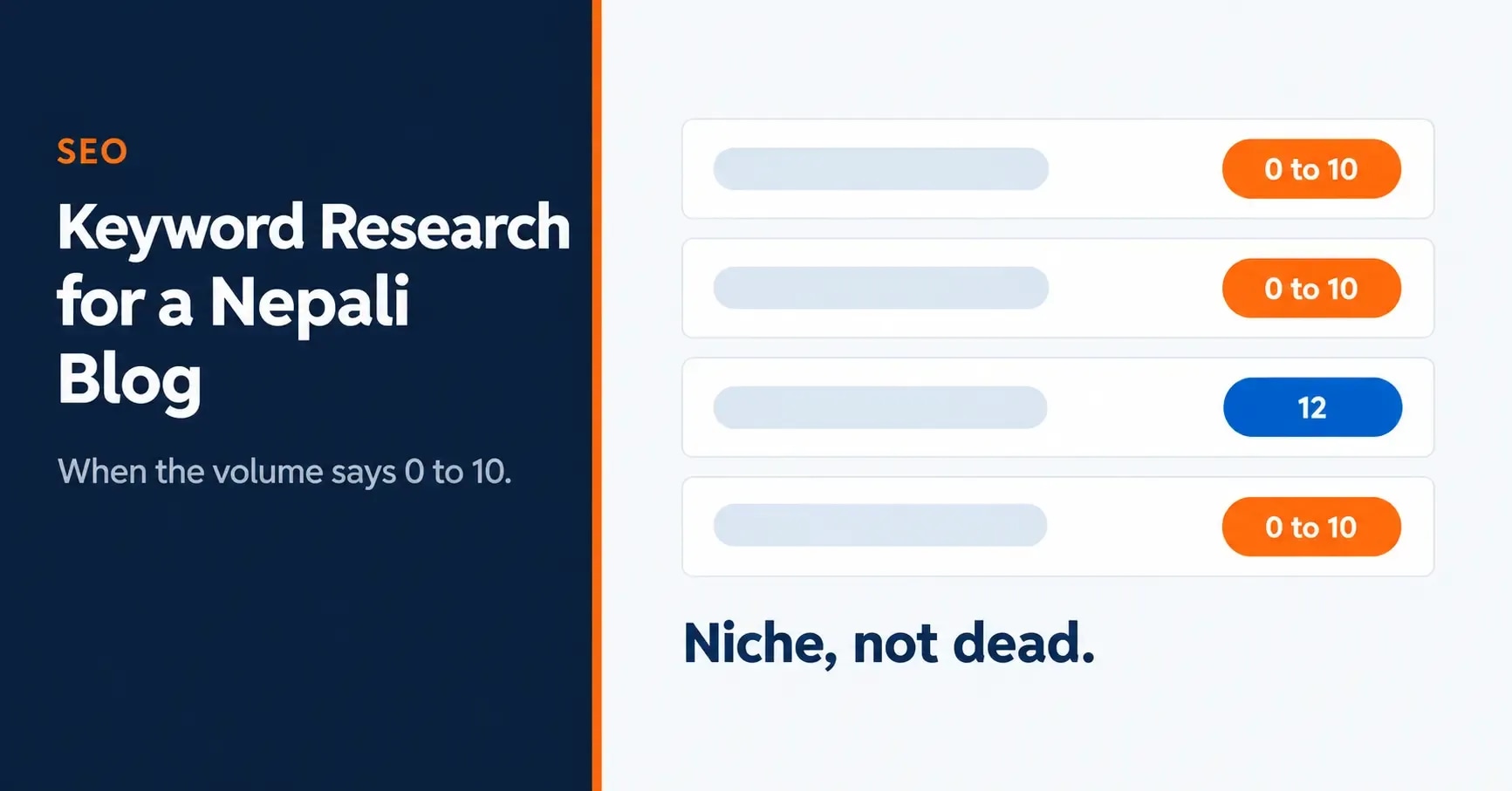
Table of ContentsOn this page
- Why the numbers look so discouraging
- Step 1: Set the location before anything else
- Step 2: Start from seeds, not from keywords
- Step 3: What makes keyword research for Nepali blog content different
- Step 4: Read the results page before you commit
- Step 5: Cluster before you write
- What to do when a keyword shows zero volume
- Scoring keywords without trusting a difficulty number
- Using free tools without paying for the gaps
- What is specific about Nepal
- If you are doing this for a business rather than a blog
- Knowing whether it worked
- Mistakes worth avoiding
- The bottom line
- Frequently Asked Questions
- Sources and References
Key Takeaways
- Low volume is normal in Nepal. A keyword showing 0 to 10 searches needs validating, not discarding.
- Set the location to Nepal before searching, or Keyword Planner returns global numbers you cannot reach.
- Google rounds Keyword Planner volumes, so treat every figure as an indication rather than a measurement.
- Test English, Romanized Nepali and Devanagari. The three rarely return the same demand.
- Score keywords on relevance, intent value, demand evidence and SERP attainability instead of difficulty alone.
- Zero volume is not permission to publish thin pages. Combine related low-volume phrases into one strong page.
- Publish two to three weeks before Dashain or Tihar, because festival searches peak and collapse quickly.
Keyword research for Nepali blog content usually starts the same way. Open Keyword Planner, set the location to Nepal, type in the topic you want to write about, and there is a good chance the screen tells you 0 to 10 searches per month.
Most keyword research advice has no answer for that, because it was written for markets where a niche keyword still returns four figures. In Nepal it does not, and the usual reaction is to assume the topic is dead and go looking for something bigger. That instinct is wrong, and acting on it is how Nepali bloggers end up writing about subjects they do not know for an audience that is not theirs.
This guide covers the work at the scale Nepal actually operates at: the five steps, how to validate a keyword the tools say has no demand, and how to decide what deserves its own page.
Why the numbers look so discouraging
Two things are happening at once, and separating them helps.
The first is real. Nepal is a small search market, so a topic that would return thousands of monthly searches in the United States might return dozens here. That is a fact about the country, not about your idea.
The second is a measurement artefact. Google states in its own documentation that "your search volume statistics are rounded", and that historical figures like average monthly searches "are only shown for exact matches" [1]. So the number you see is approximate before the market size is even considered. A "0 to 10" reading tells you the term is niche. It does not tell you the term is dead.
What follows is a different way of choosing. In a market this size, volume is close to useless as a filter on its own. The question worth asking is whether you can answer the query better than whatever currently ranks, and in Nepali niches the honest answer is often yes, because what ranks is frequently thin or written for somewhere else.
Step 1: Set the location before anything else
This is the step beginners miss, and it invalidates everything downstream.
In Keyword Planner, set the location to Nepal before you search. Without it you are reading global demand, which will look encouraging and mean nothing. A keyword showing 40,000 searches globally might have 90 in Nepal, and those 90 are the only ones you can realistically reach.

Keyword Planner is free. You need a Google Ads account to reach it, but you do not need to run ads.
Step 2: Start from seeds, not from keywords
A seed is a broad topic rather than a search term. For a trekking blog the seeds might be trekking routes, permits, gear, and costs. For a personal finance blog: saving, investing, remittance, insurance.
Write down five to ten. You will not target these directly. They are the input that produces the terms you will actually target, and starting here stops you from fixating on one phrase before you know what exists around it.
One addition for a blog rather than a business site: start from what you can credibly write about at length. A keyword you cannot answer better than the current results is not an opportunity, whatever the tool says.
Step 3: What makes keyword research for Nepali blog content different
People search the same idea three different ways here, and skipping this check is the most expensive mistake on this page.
| How it is typed | Example form | Typically used for |
|---|---|---|
| English | "best trekking routes Nepal" | Technical, commercial and travel topics |
| Romanized Nepali | "sasto trekking route" | Conversational searches, often on mobile |
| Devanagari | written in Nepali script | Cultural, news and festival topics |

Run your seeds through all three. The results are rarely the same, and the gap between them is often where the opportunity is, because most competing blogs test only one.
There is no shortcut. You are looking for how your actual readers type, which depends on the topic, the age of the audience and whether they are searching on a phone.
Step 4: Read the results page before you commit
Once you have candidate keywords, stop looking at tools and look at Google.
Search the term with the region set to Nepal and read the first page properly. What kind of pages rank: guides, lists, forums, product pages? Are they written for Nepal or for a global audience? How old do they look, and does the top result actually answer the query?
Three patterns mean a keyword is worth your time: the ranking pages are not Nepal-specific when the query clearly is, the top results are thin, or the results do not match the format the query implies. Any of those is a gap you can fill. Reading a results page for intent covers how to judge format rather than topic.
Judge the competing page, not the competing domain
Domain-level strength is the wrong unit here. You are not competing with a site, you are competing with one page.
Open the top three results and ask four questions. Does the page actually answer the query, or does it circle it? Is it written for Nepal or merely mentioning Nepal? When was it last meaningfully updated? Does it carry anything first-hand, such as real prices, dated figures or local specifics?
A large site with a thin, generic page on a Nepal query is a more realistic target than a small site with a genuinely excellent one. This step matters more in Nepal than elsewhere, precisely because the volume numbers are too coarse to decide with.
Step 5: Cluster before you write
A cluster is a group of keywords that belong to one page because they are the same question asked differently.
"Trekking permit cost Nepal", "how much is a TIMS card", and "Nepal trek permit price" are one page, not three. Splitting them creates two weak pages competing with each other, which is a problem you have made for yourself. Grouping them produces one page that can rank for all three.

Sort your list into clusters, assign one page to each, and decide which page is the main one on the topic. Topical authority covers what that looks like across a whole site.
Which keyword becomes which kind of page
Clustering tells you what belongs together. This tells you what to build.
| Keyword pattern | Likely intent | Best starting page type |
|---|---|---|
| "what is", "why", "how does" | Learning | Explainer article |
| "how to", "steps", "guide" | Doing | Step-by-step guide |
| "best", "top", "vs" | Comparing | Comparison or review |
| "cost", "price", "fee" | Budgeting | Costs page with real figures |
| "near me", city or district names | Local | Location-specific page |
| Brand or product name | Navigational | Leave it alone unless it is yours |
Mapping before you write prevents the common failure where a comparison query gets answered with a how-to article and never ranks, however good the writing is.
What to do when a keyword shows zero volume
This is the situation this guide exists for, so it gets a proper method rather than reassurance.
A zero-volume reading needs a second look, not an automatic yes or no. Work through this sequence:
- Check Search Console. Does the phrase, or something close to it, already appear for your site? First-party data beats any tool estimate.
- Test close variants. Reword it three or four ways. Volume often sits on a phrasing you did not try first.
- Check autocomplete. Type it into Google and watch what completes. Suggestions come from real searches.
- Search it and read the results. If Google returns a coherent, relevant results page, people are searching something near it. If the results are incoherent, that is your answer.
- Check Google Trends [2] with the region set to Nepal, if there is enough data to show anything.
- Look outside search. Questions in your email, comments, community groups or client calls are demand evidence even when no tool reports it.
- Ask whether it needs its own page at all. This is the one people skip.
That last point carries most of the weight. A low-volume phrase can be genuinely valuable as a subsection or a secondary query inside a bigger page, without deserving a URL of its own.
Zero volume is not permission to publish thin pages
If five low-volume phrases describe the same problem, they are one strong resource, not five weak ones.
Publishing a separate near-identical guide for each fragments your signals, makes internal linking harder, and leaves several pages competing with each other. One clear page is almost always the better architecture, and Google finds pages primarily through links from pages it has already crawled [3], so scattering your coverage across thin URLs works against discovery as well as against ranking.
Scoring keywords without trusting a difficulty number
Keyword Difficulty is useful for comparing two keywords inside one tool. It is not a strategy, and it is particularly unreliable in small markets where the sample behind it is thin.

A simple score on four inputs does more work. Rate each from 0 to 3 and read the total.
| Score | Relevance | Intent value | Demand evidence | SERP attainability |
|---|---|---|---|---|
| 0 | Poor fit | No useful next step | No evidence found | Results clearly beyond you |
| 1 | Loose fit | Mostly awareness | One weak signal | Strong results, little gap |
| 2 | Good fit | Useful traffic | Multiple signals | Competitive but realistic |
| 3 | Core fit | High value to you | Strong first-party evidence | A clear gap you can fill |
A keyword scoring 9 or more is worth writing. Below about 6, it probably belongs inside another page rather than having its own.
The point of scoring this way is not precision. It is to stop one proprietary metric from making the decision for you, which is exactly the trap a 0-to-10 volume reading sets.
Using free tools without paying for the gaps
Four free sources cover the work for a new blog.
| Tool | What it gives you | Limitation worth knowing |
|---|---|---|
| Google Keyword Planner | Volume estimates with Nepal targeting | Figures are rounded, and low-volume terms collapse into 0 to 10 |
| Google Trends | Direction and seasonality by region | Relative interest, never absolute numbers |
| Google Search Console | The queries your own pages already appear for | Only works once the site has data |
| Google itself | Autocomplete and related searches | Suggestions, with no volume attached |
The last one is underrated. Type your keyword into Google, work through the alphabet one letter at a time after it, and read the "related searches" block at the foot of the results. Those are real queries, and they cost nothing.
Search Console is the one to set up early, because it is the only free source showing what your site appears for rather than what the market does in aggregate. The Search Console setup guide covers it.
Paid tools exist and do real work, mostly around competitor analysis and difficulty scoring. Their free tiers change often enough that any limit quoted here would be out of date before long, so check the current terms yourself rather than trusting a number in a blog post, including this one.
What is specific about Nepal
Three things that generic guides have no reason to mention.
Location modifiers do more here. Adding Nepal, or Kathmandu, or a district name narrows competition sharply and signals local intent. Someone searching for investment options in Nepal wants Nepal-relevant advice, and far fewer pages compete for that than for the unmodified version. Use modifiers where the intent is genuinely local, not as a habit.
Festival timing is a cliff, not a curve. Searches around Dashain, Tihar and the Nepali new year rise steeply and fall just as fast. Google Trends [2] with the region set to Nepal will show you the shape. Publish two to three weeks before the peak, because a page published the day before has not been crawled, indexed and assessed in time to appear while anyone is looking.
The Bikram Sambat calendar matters for dated content. Nepali searches frequently use BS years rather than Gregorian ones. If you write anything year-specific, check which calendar your audience is searching in, and put a review date in your own calendar, because that content ages twice as fast.
If you are doing this for a business rather than a blog
The workflow is the same. What changes is what you prioritise and what you measure.
| Item | Nepali blog or publisher | Nepal business website |
|---|---|---|
| Prioritise | Informational clusters, recurring questions, depth | Service, product, local and comparison queries |
| Measure | Organic growth, readership, signups, affiliate outcomes | Leads, calls, bookings, enquiries |
| Map intent to | Articles, pillar and supporting pages | Service and product pages |
| Use modifiers | Where the information is genuinely local | Where city or service area changes the answer |
If you are running a business site, the scoring table above matters more than the volume column, because a keyword with ten searches and buying intent can be worth more than one with a thousand and none.
Knowing whether it worked
Keyword research is not finished when the list is. Three checks, over a window long enough to mean something:
- Impressions before clicks. A new page usually appears before it earns traffic. Impressions rising with no clicks means you are ranking too low, not that the keyword was wrong.
- Which queries Google actually gives you. Search Console will show you phrasings you never targeted. That is a correction worth reading, and often a better keyword than the one you picked.
- Whether two of your pages are appearing for one query. Filter by the query, check the Pages tab, and look for more than one of your URLs. That is cannibalisation, and the fix is consolidation rather than more content.
Mistakes worth avoiding
- Treating 0 to 10 as a rejection. Covered above, and it is the one that costs most.
- Going broad too early. "Nepal travel" is not a keyword a new blog competes for. Start narrow enough to win.
- One page per keyword variation. The single most expensive habit on this list.
- Ignoring intent. "Annapurna trek" could be someone researching, someone looking for an agency, or someone ready to book. Three different pages.
- Forcing the phrase into the writing. If a sentence exists to hold a keyword, cut it.
- Assuming the language before checking. You may be writing in English for an audience searching in Nepali, or the reverse.
- Never revisiting. A page on page two often needs updating rather than replacing.
The bottom line
Keyword research for Nepali blog content is the same discipline practised at a different scale. The tools are the same, the reasoning is the same, and the numbers are smaller and blurrier than the tools pretend.
Set the location. Test all three ways people type. Read the results page, because in a small market it tells you more than the volume figure does. Validate the zero-volume terms instead of discarding them, score on fit rather than difficulty, then cluster and write the page that is genuinely better than what is there.
Frequently Asked Questions
Why do Nepali keywords show 0 to 10 searches?
Because the market is small and Keyword Planner rounds its figures. Nepal has a fraction of the search volume of the markets most SEO advice is written for, so a term that genuinely gets traffic can still display as 0 to 10. Treat it as a signal that the keyword is niche, then validate it before deciding.
Should I target Nepali or English keywords?
Test both, plus Romanized Nepali, because the answer changes by topic. Technical and commercial topics often get searched in English even by Nepali speakers. Cultural, festival and everyday topics are more likely to be searched in Nepali, sometimes in Devanagari and sometimes in Roman letters. Checking all three takes minutes and frequently changes the answer.
Is Google Keyword Planner free?
Yes. You need a Google Ads account to access it, but you do not need to run ads. The figures it returns are rounded, which Google states in its own documentation, so treat them as approximate. Setting the location to Nepal before you search is the step beginners most often miss.
How do I validate a zero-volume keyword?
Check whether the phrase already appears in Search Console, test close variants, look at Google autocomplete, search it and see whether the results page is coherent, and check Google Trends if there is enough data. Then ask whether it belongs inside a broader cluster rather than needing its own page. Most low-volume phrases are subsections, not articles.
Should I write a separate page for every keyword?
No, and doing so is one of the most expensive mistakes available. Near-identical keywords belong on one page. Splitting them fragments your signals, makes internal linking harder, and leaves two weak pages competing with each other instead of one that wins.
Do I need a paid keyword tool?
Not to start. Keyword Planner, Google Trends, Search Console and Google's own autocomplete cover the work for a new blog. Paid tools earn their cost once you are publishing often enough that the manual version costs real hours, which is usually later than people expect.
Sources and References
Was this guide helpful?
Your answer helps Anobee improve future updates.

Written by
Bibek Thapa
AI-Powered Digital Growth Strategist
Bibek Thapa works across AI workflows, SEO, AI search optimization, content strategy, website growth, and productivity systems at Anobee.
- AI workflows
- Digital growth
- SEO
- GEO
- AEO
- Content strategy
- Website growth