AI Tools & Workflows
Best AI Visibility Tracking Tools in 2026: 6 Paid Trackers and 3 Free Checks
By Bibek Thapa · Updated · 12 min read
Quick Answer
OtterlyAI is the cheapest standalone tracker ($29 a month for 15 prompts). Peec AI suits teams, Profound suits funded enterprise programs, and Semrush, Ahrefs Brand Radar or SE Ranking fit teams already paying for that suite. Before you pay, use the free Generative AI report in Google Search Console, a free brand check and a fixed prompt log.
Table of ContentsOn this page
- AI visibility tracking tools compared
- What an AI visibility tracker measures
- Start free: three checks Anobee ran on itself
- The six paid AI visibility tracking tools
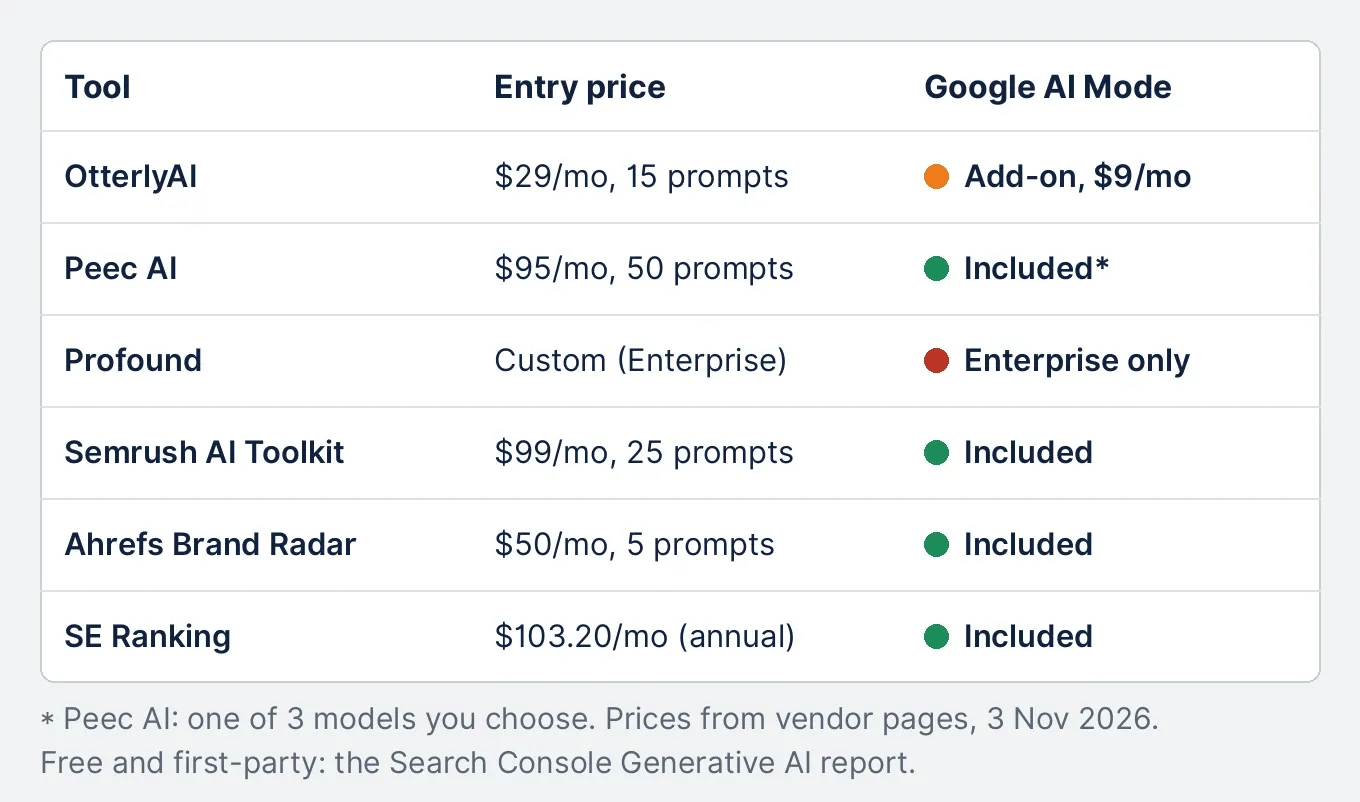
- Which AI visibility tracking tools cover Google AI Mode?
- Which tool should you choose?
- How to run a fair trial
- The bottom line
- Frequently Asked Questions
- Sources and References
Key Takeaways
- Prices change fast. Profound no longer lists a $99 Starter plan, and Semrush prompt tracking now covers ChatGPT and Google AI Mode.
- Search Console has a free Generative AI report. It showed 2.14K AI feature impressions for Anobee, out of 47K web impressions.
- Ahrefs' free checker found one Anobee mention, about paint brushes. It was a different brand with the same name.
- In three Google AI Mode prompts, Anobee was mentioned or cited 0 times. A fixed prompt log costs nothing and shows where you stand.
- Pay only when your prompt list is stable and someone will act on the data every week.
AI visibility tracking tools send the same questions to ChatGPT, Google AI Overviews, AI Mode, Gemini, Perplexity and other assistants on a schedule. They then record whether your brand was named, whether your site was cited and which competitors appeared instead. For most buyers, the shortlist is short. OtterlyAI is the cheapest standalone tracker. Peec AI is built for teams, and Profound for funded enterprise programs. Semrush, Ahrefs Brand Radar and SE Ranking make sense when you already pay for that SEO suite.
Before paying for any of them, run the three free checks in this guide. Anobee ran them on its own site on 3 November 2026, and one of them returned a result that a paid dashboard could easily have counted as a win.
How this guide was researched: every price and limit below comes from the vendor's own pricing or help page, checked on 3 November 2026. Anobee did not buy any of the six paid tools, so this guide does not judge their dashboards or data accuracy. The free checks were run on anobee.com in Bibek Thapa's Chrome browser: Google Search Console, Ahrefs' free AI Visibility Checker (no sign-up) and three prompts in Google AI Mode. No vendor paid to be included, and Anobee does not sell an AI visibility tracker.
AI visibility tracking tools compared
| Tool | Best for | Entry price (3 Nov 2026) | Prompts at entry | Google AI Mode | Free option |
|---|---|---|---|---|---|
| OtterlyAI | Solo marketers, small teams | $29/month (Lite) | 15 | Add-on, $9/month on Lite | Free trial [1] |
| Peec AI | In-house marketing teams | $95/month (Starter) | 50 | Included, as one of 3 chosen models | None listed [2] |
| Profound | Funded enterprise AEO programs | Custom (Enterprise) | Custom | Enterprise only | 7-day trial, 50 prompts [3] |
| Semrush AI Visibility Toolkit | Existing Semrush users | $99/month | 25 | Included | No trial [4] |
| Ahrefs Brand Radar | Research-heavy SEO teams | $50/month (custom prompts) | 5 | Included | Free one-time checker [5] |
| SE Ranking | Agencies reporting SEO and AI together | $103.20/month (Core, annual) | 25 daily | Included | 14-day free trial [6] |
Treat every figure as a dated checkpoint. Between August and November 2026, Profound removed its $99 Starter plan from its pricing page. In the same months, Peec AI published its prices and Semrush changed which engines its prompt tracking covers.
What an AI visibility tracker measures
An AI visibility tracker stores the answers to a fixed set of prompts and reports three separate things:
- Mentions. The answer names your brand.
- Citations. The answer links to your site as a source.
- Share of voice. How often you appear compared with named competitors on the same prompts.
Keep mentions and citations apart. An assistant can recommend your brand without linking to you, or cite your guide while recommending a competitor. A single combined score hides that difference.
AI answers also change between two runs of the same question. In contrast, a rank tracker watches one ordered list of results. AI visibility tracking samples a moving answer, so trends over weeks matter more than any single day.
Start free: three checks Anobee ran on itself
A paid tracker answers "how often do we appear?" Three free checks can tell you whether you appear at all, which is the first question for most sites.
1. Google Search Console's Generative AI report
Search Console now has a separate performance report for generative AI features. Google announced it on 3 June 2026 and says it reached all websites by 31 August 2026 [7]. It counts how often URLs from your site appeared in generative AI features such as AI Overviews and AI Mode. You can break it down by page, country, device and date. The same impressions are also included in the main Performance report [7].
To open it, go to Performance, then Generative AI in the left menu.
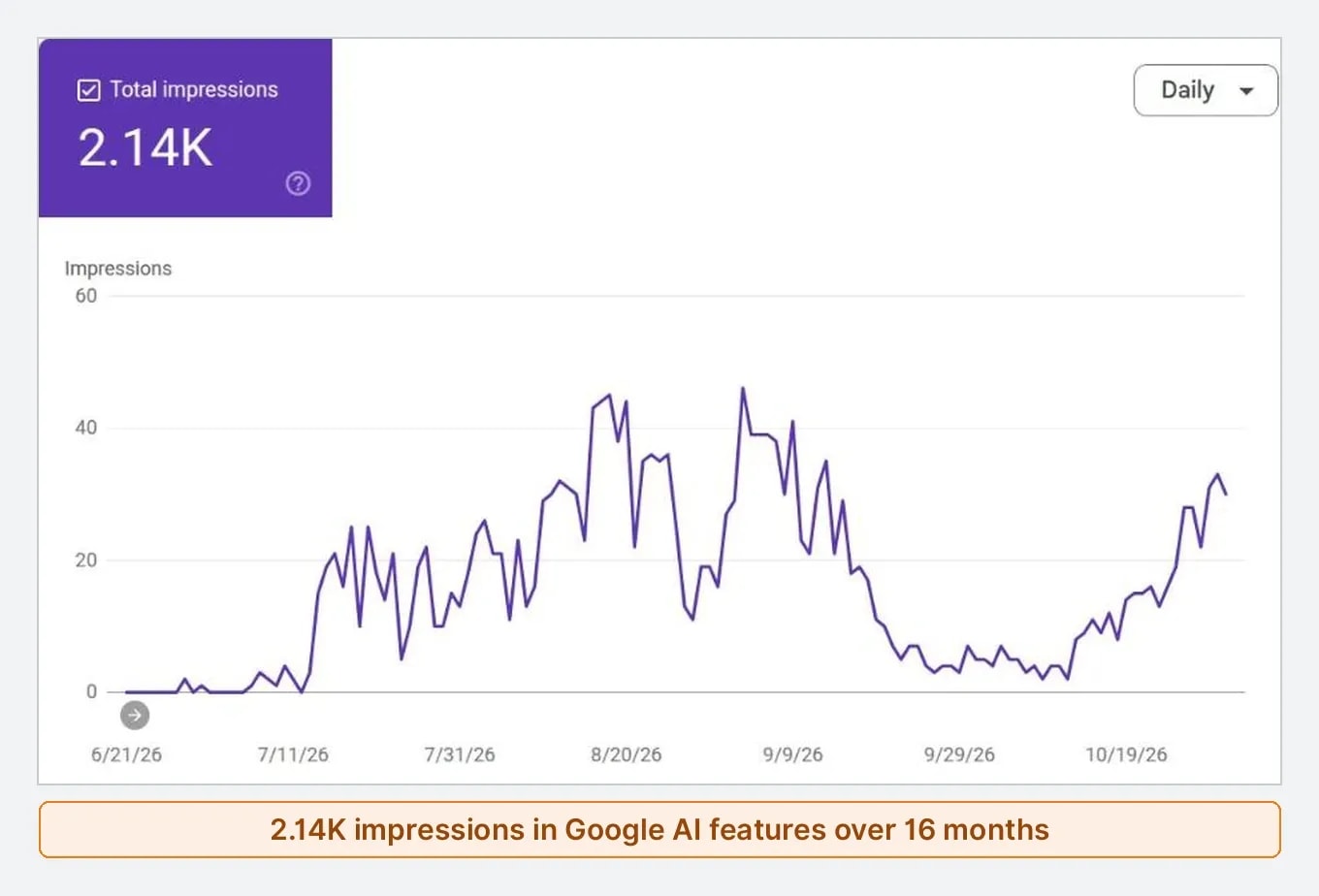
For anobee.com, the report showed 2.14K impressions in generative AI features over 16 months. Over the same period, the main web search report showed 47K impressions. Daily AI impressions started in early July 2026, peaked at about 45 a day in late August, fell close to zero in early October, and climbed back to about 30 a day by the end of October.
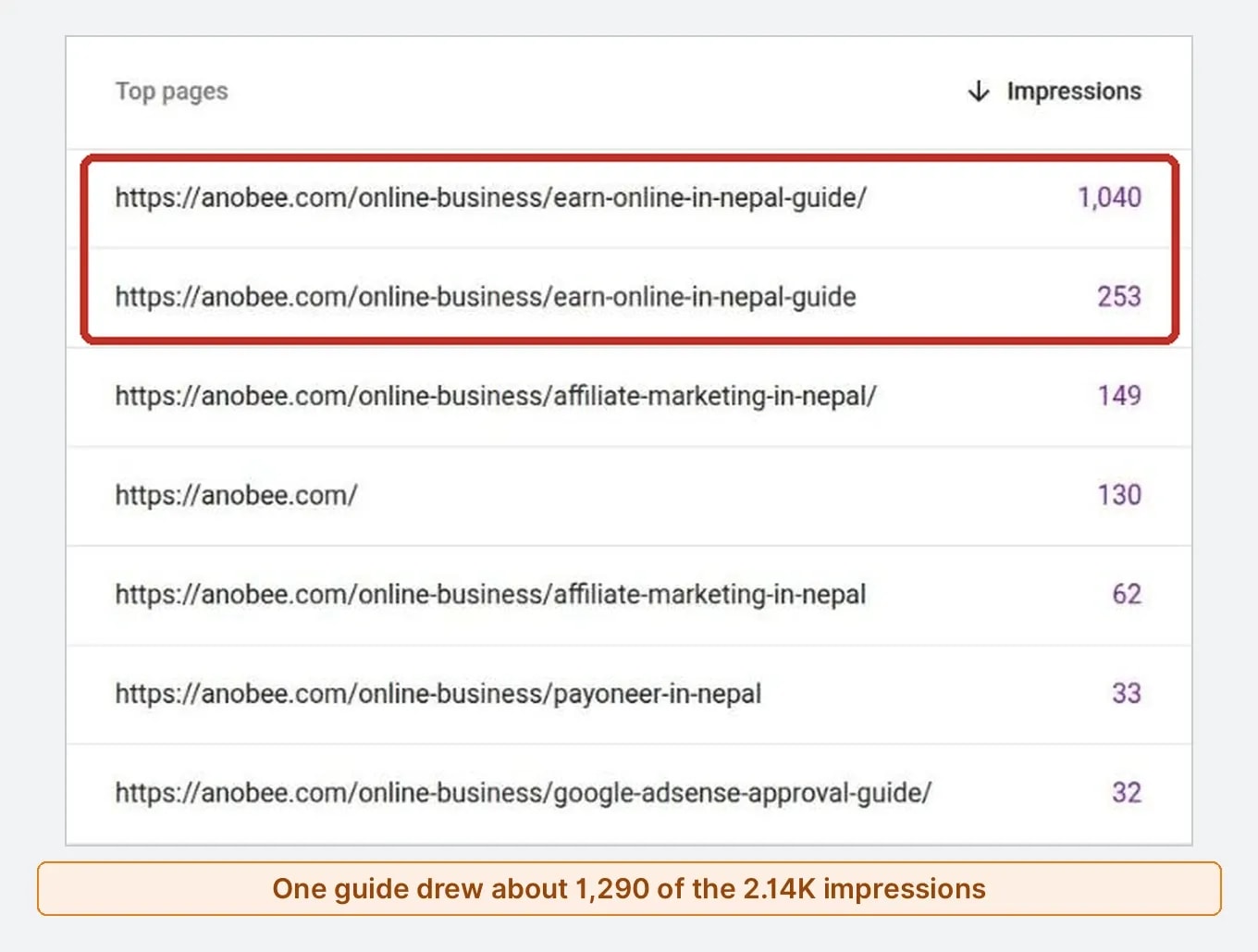
In practice, the page breakdown was the useful part. The guide to earning online in Nepal collected about 1,290 of the 2.14K impressions, counting both versions of its URL. Pages on SEO tools barely appeared, even though they have the most search impressions on the site.
What the report does not show matters just as much:
- Impressions only, with no AI-specific click metric.
- No Queries tab, so you cannot see which questions triggered the appearance.
- No split between AI Overviews and AI Mode.
- Google only. ChatGPT, Perplexity and Gemini are outside it.
Even so, it is first-party Google data and costs nothing. Check it before you buy any tracker that estimates Google AI visibility.
2. Ahrefs' free AI Visibility Checker
Ahrefs offers a free AI Visibility Checker that needs no sign-up. It checks a brand name against Ahrefs' database of search-backed prompts and returns total mentions, mentions by platform, top topics and the domains cited alongside the brand [8].
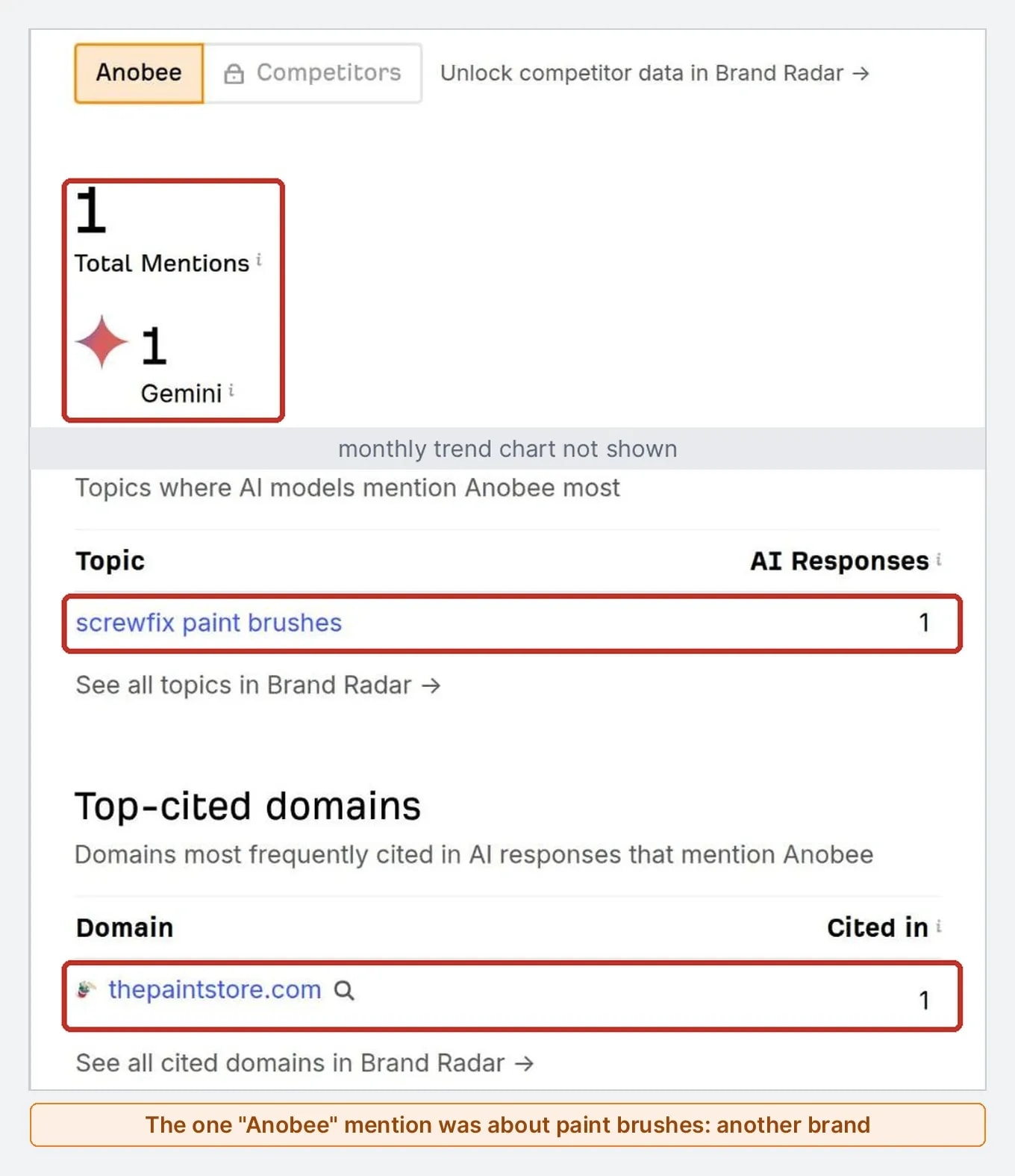
For "Anobee", it returned one mention, in Gemini, in July 2026. The topic was "screwfix paint brushes", and the cited domain was a paint store's paint brush page.
However, that mention is not about anobee.com. It belongs to a paint brush product that shares the name. Any brand-name tracker can make this mistake, free or paid, when two brands share a word. The count went up by one, and the number by itself looked like progress. Only the topic and the cited page showed it was someone else.
Two lessons follow:
- Read the topics and cited pages before you trust a mention count.
- If your brand name is a common word or shared with another company, track your domain citations and branded phrases, not the bare name.
3. A fixed prompt log in Google AI Mode
The third check is manual. Write a short list of questions your buyers ask, run them in the engines you care about, and record what happens. Anobee ran three prompts in Google AI Mode on 3 November 2026, each tied to a topic Anobee already covers:
| Prompt | Anobee mentioned | Anobee cited | Brands or sites the answer used |
|---|---|---|---|
| best AI visibility tracking tools for a small blog | No | No | Otterly.AI, Semrush, Rank Math, Peec AI |
| how can I check if ChatGPT or AI Overviews cite my website | No | No | Ahrefs, Semrush and Frase free checkers |
| free llms.txt generator and AI crawler checker | No | No | Swetrix, Adjoltz, SEOcrawl, Ahrefs and others |
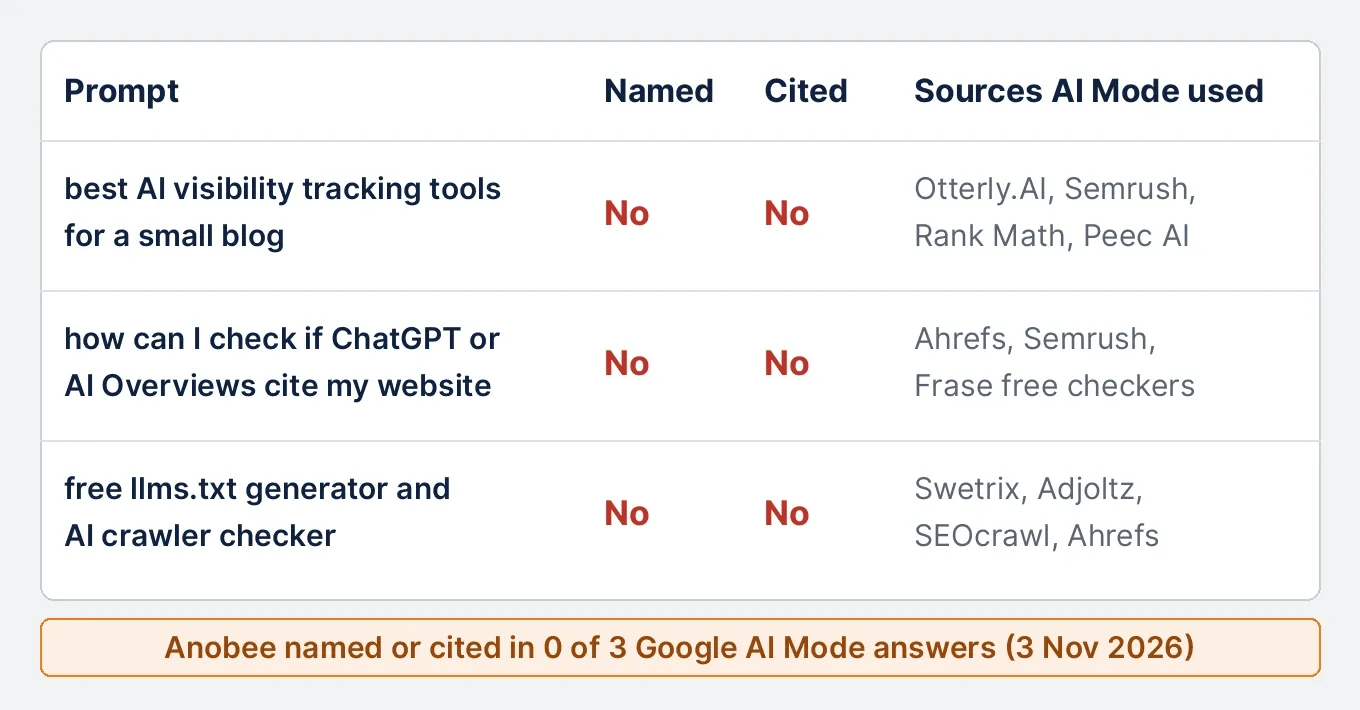
Zero out of three is a starting point. Anobee publishes a guide to checking AI citations and runs a free AI crawler checker and llms.txt generator. AI Mode still chose other sources. That is the gap a tracker would measure each week. For a three-prompt list, a spreadsheet does the same job.
One caution: AI Mode showed a "Try without personalization" link, so these answers may reflect the signed-in browser. Run your log in the same account state every time.
The six paid AI visibility tracking tools
1. OtterlyAI: the cheapest standalone tracker
OtterlyAI's Lite plan costs $29 a month for 15 search prompts, tracked daily across ChatGPT, Google AI Overviews, Perplexity and Microsoft Copilot. Google AI Mode and Gemini cost $9 a month each on Lite, and Claude costs $29 a month. Lite also includes unlimited team members, brand sentiment, citation source tracking and a GEO audit. Standard costs $189 a month for 100 prompts, and Premium costs $489 a month for 400 prompts. OtterlyAI offers a free trial [1].
Fifteen prompts is a small allowance, and that suits a first test. Pick fifteen questions that matter to your business and watch them for a month before adding more.
Add-on engines change the real price. Lite with AI Mode, Gemini and Claude costs $76 a month.
2. Peec AI: built for teams sharing the work
Peec AI's Starter plan costs $95 a month for 50 prompts, tracked daily, with unlimited seats and one country. You choose three active models from ChatGPT, AI Mode, AI Overviews, Microsoft Copilot, Gemini and Naver AI. Pro costs $245 a month for 150 prompts and three countries, and Advanced costs $495 a month for 350 prompts. Claude, Perplexity and API-based models appear only on Enterprise [2].
For a team, unlimited seats matter more than the headline price when several people review the same answers or split prompts across brands.
The catch: three active models means you must decide which engines matter before you compare Peec with a tool that lists more engines. Perplexity is not on the self-serve plans.
3. Profound: for an enterprise AEO program
Profound's pricing page now lists two plans. The free Trial tracks 50 prompts daily for seven days across ChatGPT, Gemini and Google AI Overviews. Enterprise has custom pricing and tracks up to nine answer engines: ChatGPT, Perplexity, Google AI Mode, Gemini, Microsoft Copilot, DeepSeek, Claude, Google AI Overviews and Exa Search [3].
The seven-day trial is the most generous free test among the paid tools here. Use it with the prompt list you already wrote for your manual log.
After the trial, though, the only listed plan is a custom Enterprise contract that starts with a demo. A small publisher is unlikely to get past that step.
4. Semrush AI Visibility Toolkit: easiest for Semrush users
The Semrush AI Visibility Toolkit costs $99 a month, with no free trial. It includes 25 prompts for Prompt Tracking, which covers Google AI Mode and ChatGPT. Brand Performance analysis covers one domain, and each extra domain or location costs $99. Fifty more prompts cost $60 a month [4].
The value is the workflow. AI tracking sits beside rankings, audits and reports a Semrush team already uses.
One detail to check: the help page lists AI Mode and ChatGPT for Prompt Tracking. Perplexity and AI Overviews are not named there, so confirm the engine list for the plan you buy.
5. Ahrefs Brand Radar: broad discovery first
Ahrefs Brand Radar has two parts. Custom Prompts track your own questions and start at $50 a month, with 5 prompts and 150 checks on the smallest plan. The AI Visibility Index searches Ahrefs' database of search-backed prompts and starts at $199 a month. All platforms cost $699 a month and include 2,500 custom-prompt checks. The index covers AI Overviews, AI Mode, ChatGPT, Perplexity, Gemini and Copilot, and Custom Prompts add Claude [5].
The index is strong for discovery: finding the questions where competitors appear and you do not.
Read the plan name carefully. A $50 prompt package and the $699 all-platform plan are very different products under one name. And as the Anobee test showed, index mentions need checking for same-name brands.
6. SE Ranking: useful when reporting is the product
SE Ranking's Core plan costs $129 a month, or $103.20 a month billed annually, and Growth costs $279 a month, or $223.20 annually. Core and Growth include AI visibility tracking for 25 prompts daily across five AI engines. The separate AI Search add-on, SE Visible, starts at $71 a month, with prompt tiers of 75, 200 and 1,000. The pricing page names AI Overviews, AI Mode, Gemini, ChatGPT and Copilot [6].
That bundle suits an agency already sending monthly SEO reports. AI visibility becomes one more section of a report the client already reads.
If you only want to watch ChatGPT mentions, a full SEO suite is an expensive route to them.
Which AI visibility tracking tools cover Google AI Mode?
Google AI Mode is the engine many buyers ask about now, and coverage differs by plan:
- Included at the entry level: Semrush (in Prompt Tracking), Peec AI (if you choose it as one of your three models), Ahrefs Brand Radar and SE Ranking [4] [2] [5] [6].
- Paid add-on: OtterlyAI, $9 a month on Lite and $59 a month on Standard [1].
- Enterprise only: Profound [3].
- Free, first-party: the Search Console Generative AI report, which counts AI Mode and AI Overviews impressions together [7].
Which tool should you choose?
Choose by the shape of your work, not by the longest engine list.
- You run a small site and have never checked. Use the three free checks first. Buy nothing until the manual log shows a question worth tracking every week.
- You are a solo marketer with a fixed list of questions. OtterlyAI Lite, plus the AI Mode add-on if Google matters to you.
- Several people share the monitoring. Peec AI, for unlimited seats and daily tracking.
- You already pay for Semrush, Ahrefs or SE Ranking. Start with that suite's AI module. Fewer logins usually beats a slightly better standalone tool.
- AI visibility has its own budget and owner. Book the Profound trial and compare it with Peec AI Advanced.
Is it worth paying, or can you track it manually?
In short, manual tracking is enough for most small sites at first. Ten to twenty fixed prompts, run monthly in the same engines and account state, will show whether you appear at all. The free Search Console report adds Google's own count.
Paying for AI visibility tracking tools starts to make sense when three things are true: the prompt list has stopped changing, several engines or countries matter, and someone will change content based on the results every week. Without that last part, a tracker only produces a chart nobody acts on.
How to run a fair trial
Most AI visibility tracking tools offer a trial or a cheap first month. Make it count:
- Write one fixed prompt set first. Cover category questions, comparisons, alternatives, problems and buying decisions. Use the same list in every tool.
- Fix the engines, country and language. A tool that tracks the United States will not match your results in Nepal or the United Kingdom.
- Score evidence, not the dashboard. For each prompt, record mentioned, cited, and which URL was cited. Open a sample of raw answers and confirm the tool read them correctly.
- Check for false matches. Search the mentions for topics that have nothing to do with you, as the paint brush result did for Anobee.
- Calculate the real monthly cost. Add the engines, extra prompts, countries and seats you need. Entry prices rarely include all of them.
Finally, if the trial shows you are not mentioned anywhere, the fix is content and entity work, not a bigger dashboard. Anobee's guides on getting cited by ChatGPT and entity optimization for AI search cover that side.
The bottom line
AI visibility tracking tools are useful once you know which questions matter and someone will act on the answers. Before that point, the free Search Console report, a free brand check and a short prompt log tell you most of what a paid dashboard would. When you do buy, compare plans on engines, prompts and countries at the price you will actually pay, and read the raw answers behind every count.
Frequently Asked Questions
Is there a free AI visibility tracker?
There is no free tool that tracks your own prompts every day. Free options cover parts of the job: the Generative AI report in Google Search Console counts impressions in AI Overviews and AI Mode, Ahrefs' free AI Visibility Checker gives a one-time brand snapshot, and a manual prompt log in a spreadsheet tracks fixed questions. Profound also lists a free seven-day trial.
Which AI visibility tool tracks Google AI Mode?
On 3 November 2026, Semrush, Peec AI, Ahrefs Brand Radar and SE Ranking listed Google AI Mode in their plans. OtterlyAI sells AI Mode as an add-on, from $9 a month on its Lite plan. Profound includes AI Mode on its Enterprise plan, not on its free trial.
Can Google Search Console show AI Overviews traffic?
Partly. The Generative AI report in Search Console shows how often your pages appeared in generative AI features such as AI Overviews and AI Mode, by page, country, device and date. It shows impressions only. It does not list the questions people asked, and it does not split AI Overviews from AI Mode.
Is it worth paying for an AI visibility tool, or can I track it manually?
For a small site, track manually first. Ten to twenty fixed prompts checked monthly, plus the free Search Console report, will show whether you appear at all. Pay when the prompt list is stable, several engines or markets matter, and someone will act on the results every week.
Sources and References
Was this guide helpful?
Your answer helps Anobee improve future updates.

Written by
Bibek Thapa
AI-Powered Digital Growth Strategist
Bibek Thapa works across AI workflows, SEO, AI search optimization, content strategy, website growth, and productivity systems at Anobee.
- AI workflows
- Digital growth
- SEO
- GEO
- AEO
- Content strategy
- Website growth